Showing posts with label Education. Show all posts

Friday, March 17, 2017

Mercer Borris shares her experience


Health post: Medical Camps in Rural Villages


(as posted originally in https://interfacesofhealth.wordpress.com/2017/01/24/health-post-medical-camps-in-rural-villages/)

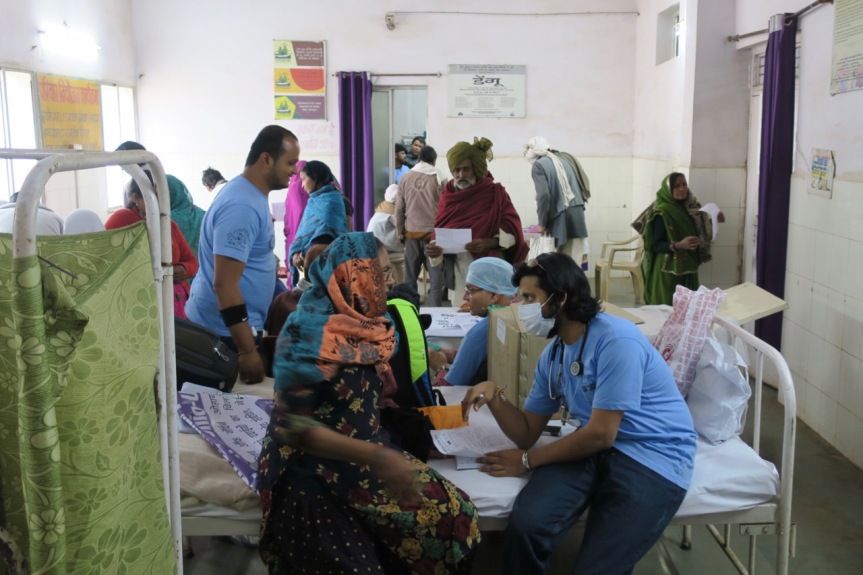
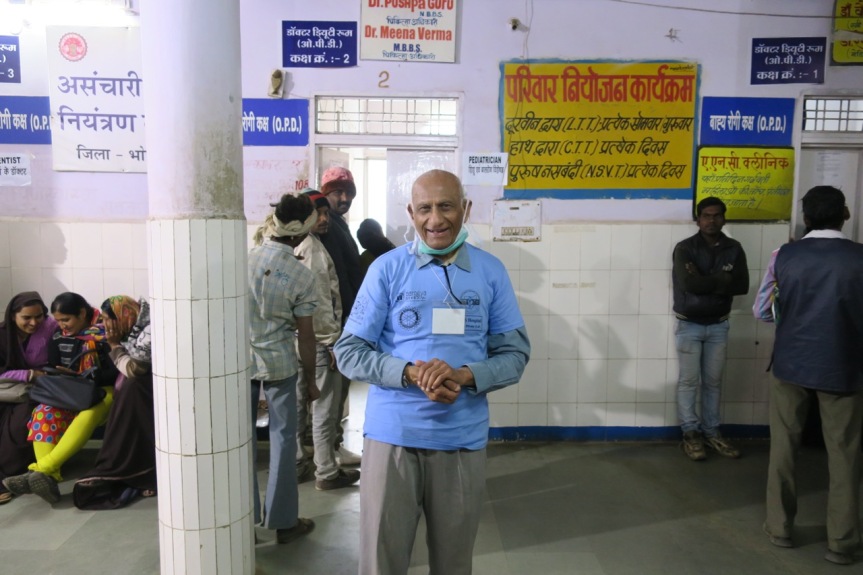
Last week I traveled to Bhopal, the tier-two capital city of Madhya Pradesh, a state in central India. I was there to participate in a health camp called Medical Yatra, which is an annual event to bring healthcare services to rural villages across the country. Each year, the Medical Yatra team convenes in a new city and spends ten days traveling out to neighboring villages. It’s a joint effort by an association of India physicians of Northern Ohio, local hospitals, the non-profit foundation Aarogya Seva, and the Rotary International club (http://www.aarogyaseva.org/medical-yatra-2017/).

IMG_3825.jpg
Aarogya Seva’s slogan is “Promoting Healthcare Volunteerism.” While I wasn’t planning on doing any volunteering on the Watson, I felt humbled to be included in the group and able to contribute in some way.

I heard about the camp because a company I interviewed for the project, MyCliniCare, was going to attend for a few days to bring their technology along with the medical supplies. MyCliniCare provides a telemedicine solution in the form of a suitcase for on-the-go healthcare. The suitcase, which can be brought to any rural area, has many small medical devices and monitors along with a laptop that synthesizes the collected data and connects to a trained doctor over a video call.
IMG_3728.jpg
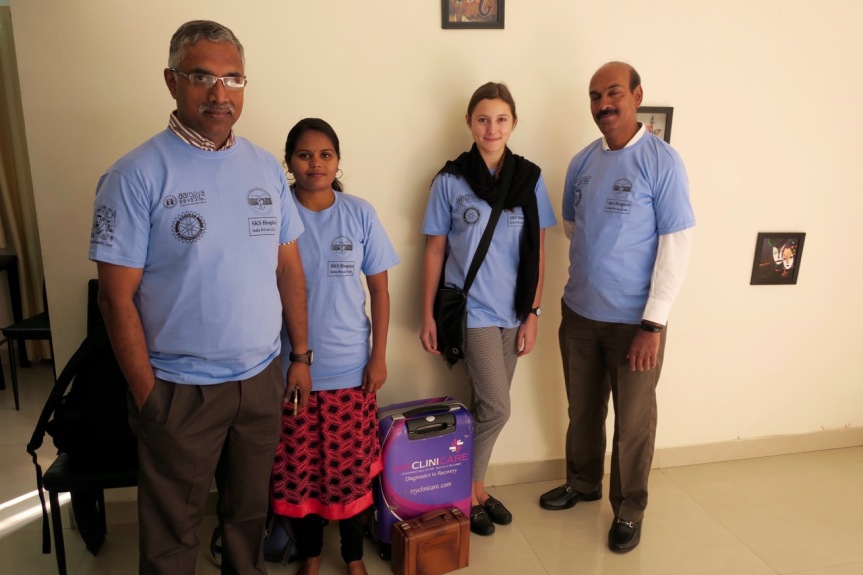
The MyCliniCare team and me in our volunteer t-shirts! The MyCliniCare suitcase is in the shot as well.
IMG_3743.jpg
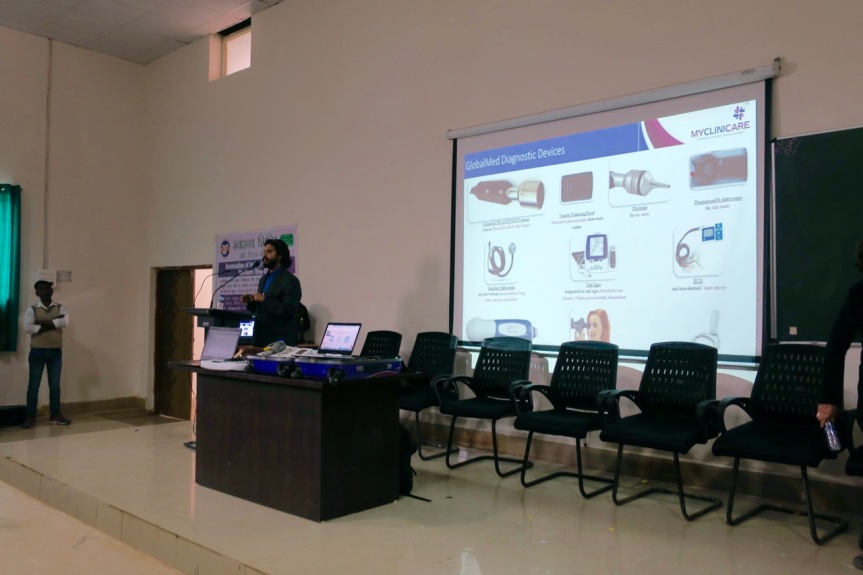
Dr. Dayaprasad, founder and director of the Aarogya Seva foundation, giving a presentation to medical students in Bhopal about the various medical diagnostic devices included in the MyCliniCare telemedicine kit.
IMG_3746.jpg
Here, Gururaja of MyCliniCare is demonstrating the telemedicine setup by pointing the multipurpose otoscope into his mouth. The resulting image of his throat is displayed on the projection screen, which is what a doctor would see remotely.

One new addition to MyCliniCare’s set is the iBreastExam device, a handheld sensor for breast tumor screening. Using piezoelectric sensors, the device checks for lumps in a patient’s breasts and delivers a result in 5-10 minutes; if it finds anything, a mammogram follow-up is required. In each village that we visited, the MyCliniCare team set up a private place for their technician to screen women with iBreastExam.

IMG_3839.jpg
The iBreastExam handheld device is pink and white, and it delivers real-time results to the connected app.
IMG_3832.jpg
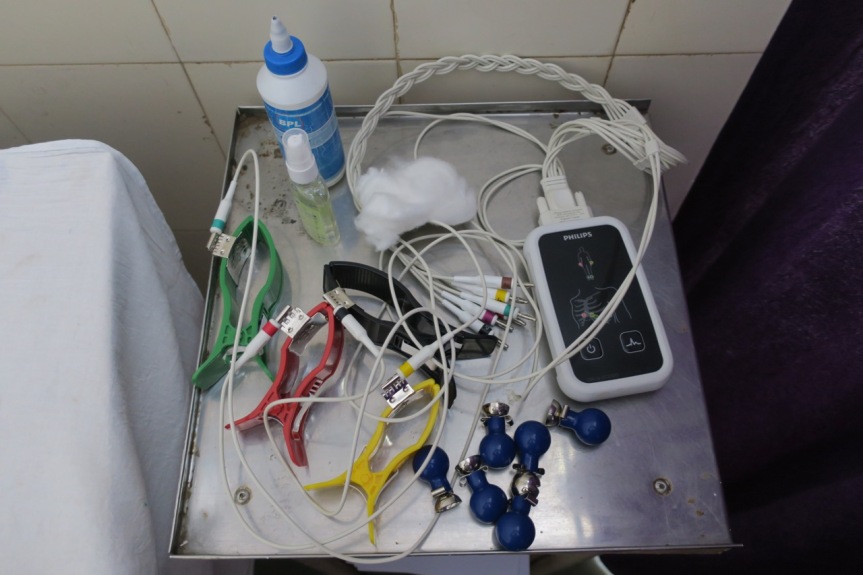
In the same room as the breast tumor screening, we performed ECGs with this portable device (which also sends its results to a smartphone app, connected via WiFi).

Though I initially intended to tag along with the MyCliniCare team and simply observe, I ended up becoming a full volunteer for a few days since the health camp needed the help. For the first two days, I teamed up with a doctor to run the blood-test station. The doctor spoke to the patients in Hindi and pricked their fingers to get blood, and I took the samples and ran the tests with the devices we had brought. We had a small hemoglobin device to test for anemia and a small glucometer to test for high blood sugar.

IMG_3782.jpg
The HemoCue hemoglobin meter that we used. Incidentally, it is made by a Swedish company!
IMG_3784.jpg
Medicines set up by the pediatricians in the same room as the blood testing.

After months of interviewing people about attitudes towards health and medical technology in rural India, it was invaluable to see those very attitudes in front of me. It felt like all of a sudden I had gone from using secondary sources for my information to primary sources. Most of the villagers were comfortable getting their blood drawn and tested, as it was a simple and quick procedure that was explained to them in Hindi. However, they rarely reacted to the results due to a general lack of awareness of how much blood sugar was too much and what that meant, as well as what the purpose of hemoglobin testing was.
A few of the villagers, especially the children, were scared to get their fingers pricked and found it quite painful (making very familiar cringing faces!). One woman in the village of Tumda sat down for a blood test, had her finger swabbed with alcohol, took one look at the little lancet that was about to pierce her fingertip, and started cursing in Hindi and nearly ran out the door. I was stunned that she hadn’t realized what a blood test entailed. Her reaction reminded me of a few interviews I’ve had here in which people have told me that many Indian patients, especially in rural areas, are resistant to invasive procedure from finger-pricking to surgery.
IMG_3815.jpg
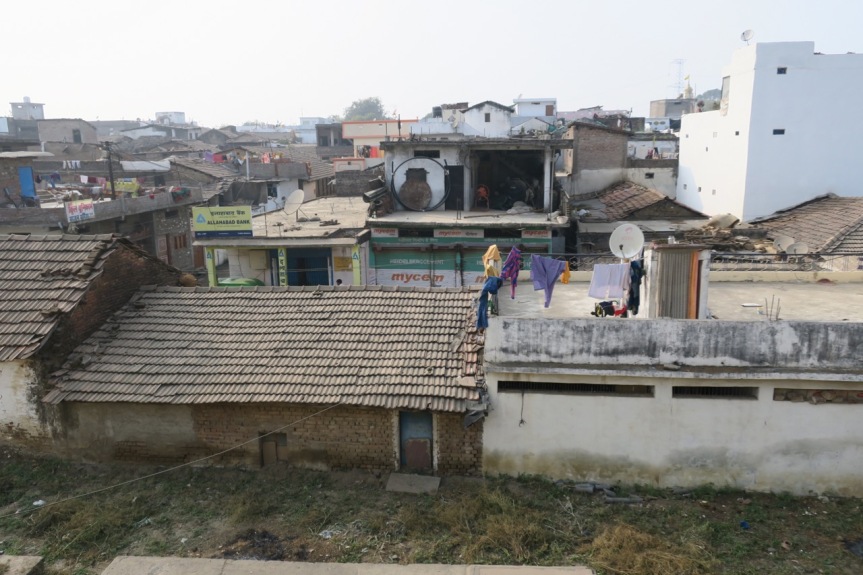
Tumda Village.
IMG_3823.jpg
As things quiet down in Tumda, the volunteers show each other how to read a classic blood pressure monitor.

As part of the camp, I traveled to the villages of Seoni, Tumda, and Berasia. I was happy that my fellow volunteers were mostly Indian; I wonder if the villagers were a bit put off by my presence (being an obvious foreigner), and it was challenging not knowing Hindi. So it was good to stay useful, and it was fascinating for me to be around so many doctors volunteering their services. Of course, the question of sustainability is always important: how do these one-off health camps help the villagers if we can’t come back to the village? The doctors I asked told me that some care is always better than no care, and the big problem is awareness – many villagers are not aware of their medical issues or how to address them. At least with a visit from specialists via this type of health camp, patients can get the right information and seek the appropriate care at a more accessible (and permanent) health center or hospital. The Medical Yatra team keeps track of all the patients that need to be referred to specific hospital departments, and they send those lists to the nearby hospitals, who then send vans to the villages to pick up the patients for free treatment at their facilities. Also, most patients do have a mobile number, so we can at least call to follow up.

IMG_3772.jpg
The school in Seoni where we set up camp.
IMG_3778.jpg
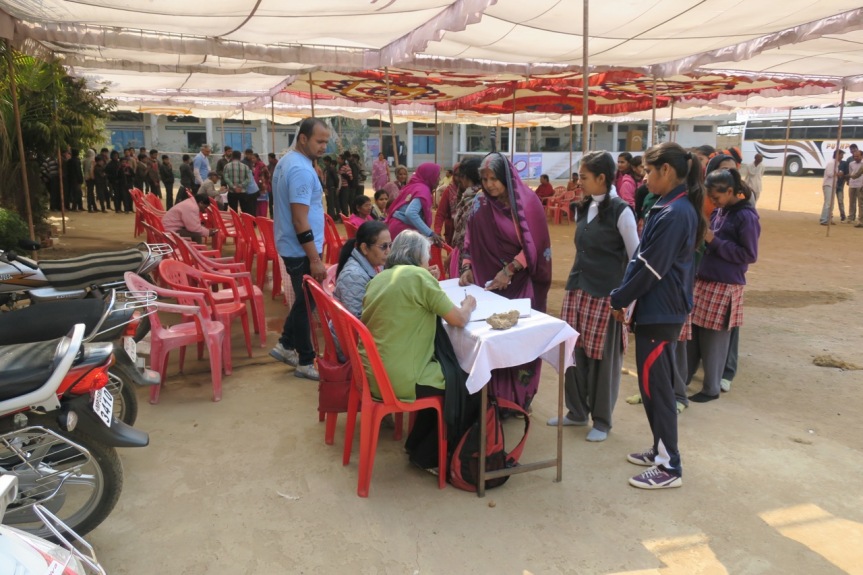
Medical Yatra volunteers registering patients for treatment.
IMG_3760.jpg
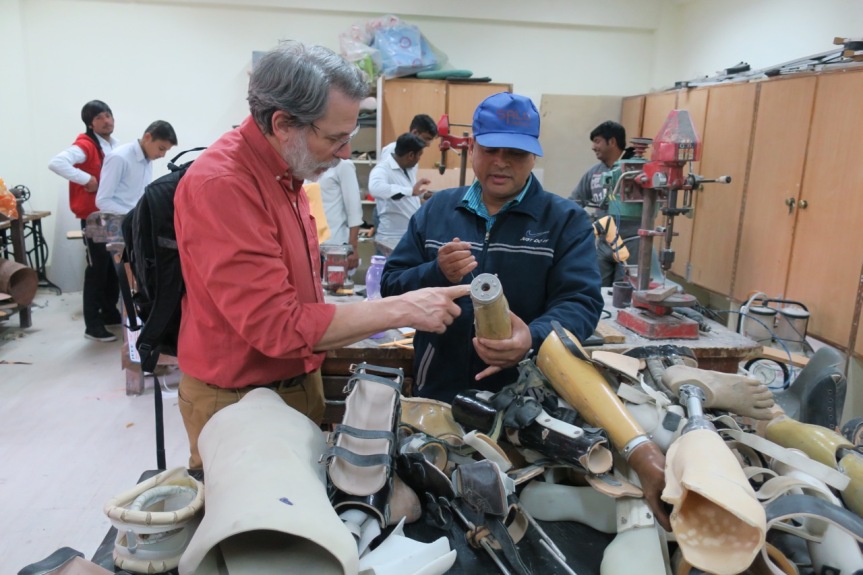
In Bhopal, we visited this government center making prosthetic limbs and offering rehabilitation techniques. Professor Schull, on the left, was interested in comparing their design to his 3D-printed prosthetic designs.
IMG_3790.jpg
One of Professor Schull’s 3D-printed prosthetic prototypes.
IMG_3840.jpg
The internal medicine room that we set up at Berasia village. The hallway just outside the room was packed wall-to-wall with patients all day.
IMG_3841.jpg
Dr. Ramesh Shah, a volunteer from Ohio.

I’m very grateful to MyCliniCare and the Aarogya Seva foundation for letting me join their effort for a few days. It was inspiring to meet so many hard-working doctors and actually operate the type of medical devices I’ve been thinking about throughout my project.

Thursday, February 25, 2016

March 8 International Women's Day Event


International Women's began with women protesting against wages and conditions within the textile industry at the turn of the 20th Century and has since grown into a global movement on March 8th. 

Annually around the world events are held that celebrate women’s contribution to society from fun runs, breakfast panels, gala events to festivals. 

We are excited to announce that AarogyaSeva will conducting an event at our soon to be open new AarogyaSeva Clinic- AarogyaSeva Karuna Clinic opposite the Lalbagh Siddapura gate on International Women’s Day.

The new AarogyaSeva Clinic centre will not only be a free clinic but also a prosthetic limb centre. Disability is an important public health problem in India with 2.6 million people living with a disability according to the 2011 census.

The clinic will house a 3-D printer with a focus on creation of upper limb prosthesis for children.   The recipients will be involved in designing, printing and assembling the limb making it an experiential and empowering process. 

It is intended that in collaboration with our partner organisations- The Challenging Ones, Association of People with Disability, IEEE, BMS College of Engineering and Rochester Institute of Technology least 25 limbs will be created in the first year.  

In additional we are seeking to use the space to provide workshops, education and awareness on 3D printing and health as well as allowing students and innovators to experiment with creating low cost medical solutions.

So please come along on March 8th and see the new clinic and support the female artists! Looking forward to seeing you all there. 

If you are interested in learning more or providing assistance please write to us at  Volunteer@aarogyaseva.org


Monday, February 15, 2016

Sanitary Napkins and Feminine Hygiene


Seeing the sanitary napkins women empowerment project whilst as part of 2016 Medical Yatra made me want to look into this topic a bit more.


For someone from a developed country we do not think much with regards to this area of female hygiene nor do we generally have any issues with access to sanitary napkins or tampons. Yet many women around the world still use scraps of dirty cloths which they cannot clean or sanitise properly.  Alarmingly I read that up to 70% of all reproductive diseases in India are caused by poor menstrual hygiene.


For so many women around the world menstruation is still a taboo subject with many restrictions placed on the women particularly around isolation as they are considered unclean.  Yet I can see why the commercially available products are not used openly and freely as women especially in rural villages have trouble to access, afford and dispose of them properly.  Further to this there is still much lacking on education on menstruation and female hygiene.


Fortunately there are several different projects currently in place using different approaches to address this issue including the use of cloths and menstrual cups.


This is the first time I’ve come across menstrual cups like SheCup or Ruby Cup. Both use a medical grade silicon cup which is inserted in the vagina like a tampon. The benefits of these are that they are much cheaper and better for the environment than commercially available sanitary napkins.   


Another project/initiative is Goonj’s Not Just a Piece of Cloth (NJPC) which was established in 2005 and has expanded globally.  They use old/discarded cloth to create reusable sanitary napkins and use this as platform to engage and educate about female hygiene whilst also providing job opportunities.  


The basis of the project that I saw at the Gram Seva Trust Hospital is related to the work Arunachalam Muruganantham and his company Jayaashree Industries.  What is particularly inspiring about Arunachalam is that he did not finish high school and that what began as a way to impress his new bride has evolved to something so much more which included him testing sanitary pads himself with the use of animal blood. I highly recommend watching Arunachalam TED talk from 2012. A documentary called 'Menstrual Man' has been created about him and his work.


What I love about the project I saw is that it is run by women for the women giving them a much needed low cost solution and income. Furthermore the pads are biodegradable reducing our impact on the environment particularly given that waste disposal is another burden particularly in rural areas.


As with all things I believe that a variety of different solutions are needed to address this issue as there is never a one size fits all to any problem.


I’d like to leave you all with an amusing advertisement we have in Australia which shows the marked difference between the countries views on the topic. https://www.youtube.com/watch?v=rg2-ZzSBl5s

Links on that mentioned above can be found below.


Disclaimer: The opinions expressed within this article are the personal opinions of the author. The facts and opinions appearing in the article do not reflect the views of AarogyaSeva and AarogyaSeva does not assume any responsibility or liability for the same.


To get in touch with the author or to join our team write to us at – Volunteer@aarogyaseva.org


Thursday, February 4, 2016

Pre Medical Yatra-Community Engagement/Education


In line with prior years, AarogyaSeva was again part of 2016 Medical Yatra organised by/in association with  AIPNO, Rotary Club of Northern Ohio, Rotary Club of Dharampur and Gram Seva Trust. This year it was held in Gujarat. 

To further broaden the volunteer experience of the Medical Yatra they organised a 2 day Community Engagement and Education program.   We were welcomed and thanked by the local schools with speeches and presentations, and song and dance.  We had a tour of the Gram Seva Trust Hospital, we participated in “Swachh Bharat” which was an initiative to clean up local community and reduce littering. We also visited local communities touring their water filtration facility, local diary collection facility/co-op and also visited the installed toilets which were made possible through Gram Seva Trust and the Rotary Club of Dharampur.   

The Gram Seva Trust was established by husband and wife team Dr Harsha and Ashwin Shah in 1994 starting as a 30 bed hospital with 5 staff has now grown to 80 bed facility with 100 staff and includes running of many community project which aims to assist women, children and the elderly including the establishment of libraries, boarding facilities for children, mobile clinics, and education on health, nutrition and hygiene.  More on Gram Seva Trust can be found: http://www.gramseva.org/


The local diary facility we visited has become its’ own social enterprise and is a co-op for the local community. The sale of the the milk has made it possible for the community to save and fund additional local initiatives such as heifer micro-lending program.  The heifer are purchased via a loan and once the cow produces milk and thus an income the loan is repaid.  The villager are then able to have a continuous sustainable income going forward for their families.  Given it’s success this co-op will be used as model for nearby villages.
Those of us from more developed countries take for granted our access to toilets. We were initially a little puzzled by our tour of several villages just to see the constructed toilets however this is actually a very important initiative for the villages as we were told stories of women being raped when they ventured out for the bathroom alone. Prior to the construction of toilets, the women would meet up as a group to go to a secluded spot in the field to do their business.

While we were there Gram Seva Trust Hospital they had a children's education fair. Just like at a fete/fair there was a jumping castle, giant snakes and ladders, ball throwing games, hola hoops etc where the children are taught about health topics whilst having fun.

By far my favourite community initiative was the sanitary napkins women empowerment project. This is run by the women for the women and provides improved health and education as well reducing the stigma around menstruation.   The sanitary napkins are made by hand from cotton and wood pulp which importantly are also biodegradable. These are then sold by women to women in their local villages at much lower cost to that which are mass produced and made from plastic and other non-biodegradable materials. This facility was based within the Gram Seva Trust Hospital and with this success they are looking to expand and replicate this to up to 15 facilities.
Key Takeaways
  • it is together that we are able to make a bigger difference
  • be grateful for running water, toilets and waste collection services
  • access to health and education and also knowledge of these are the biggest barriers to progress


There will be more on the actual Medical Yatra in the coming days.


Disclaimer: The opinions expressed within this article are the personal opinions of the author. The facts and opinions appearing in the article do not reflect the views of AarogyaSeva and AarogyaSeva does not assume any responsibility or liability for the same.
To get in touch with the author or to join our team write to us at – Volunteer@aarogyaseva.org