Showing posts with label DFS. Show all posts

Friday, March 17, 2017

Mercer Borris shares her experience


Health post: Medical Camps in Rural Villages


(as posted originally in https://interfacesofhealth.wordpress.com/2017/01/24/health-post-medical-camps-in-rural-villages/)

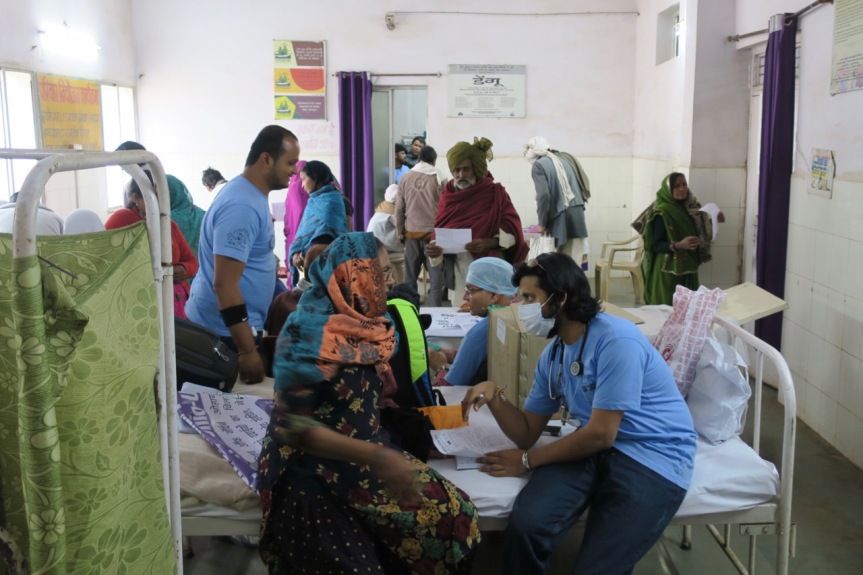
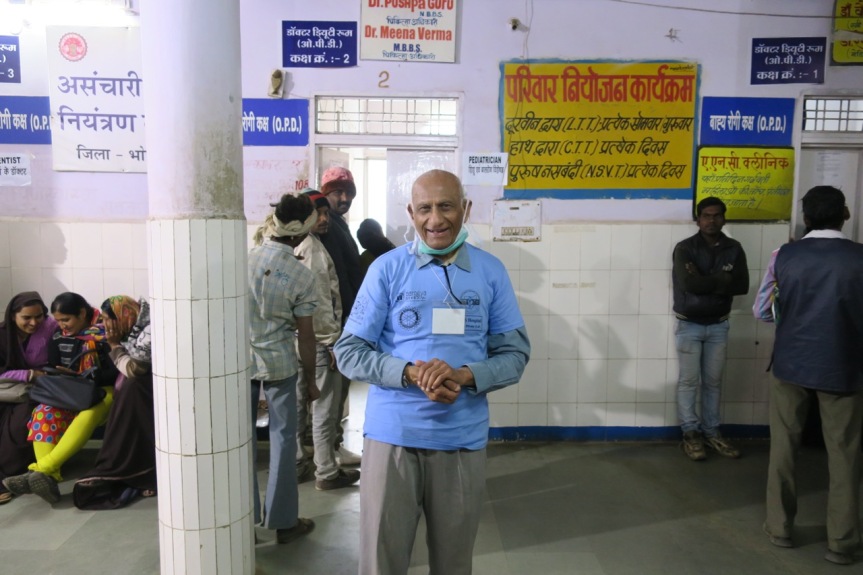
Last week I traveled to Bhopal, the tier-two capital city of Madhya Pradesh, a state in central India. I was there to participate in a health camp called Medical Yatra, which is an annual event to bring healthcare services to rural villages across the country. Each year, the Medical Yatra team convenes in a new city and spends ten days traveling out to neighboring villages. It’s a joint effort by an association of India physicians of Northern Ohio, local hospitals, the non-profit foundation Aarogya Seva, and the Rotary International club (http://www.aarogyaseva.org/medical-yatra-2017/).

IMG_3825.jpg
Aarogya Seva’s slogan is “Promoting Healthcare Volunteerism.” While I wasn’t planning on doing any volunteering on the Watson, I felt humbled to be included in the group and able to contribute in some way.

I heard about the camp because a company I interviewed for the project, MyCliniCare, was going to attend for a few days to bring their technology along with the medical supplies. MyCliniCare provides a telemedicine solution in the form of a suitcase for on-the-go healthcare. The suitcase, which can be brought to any rural area, has many small medical devices and monitors along with a laptop that synthesizes the collected data and connects to a trained doctor over a video call.
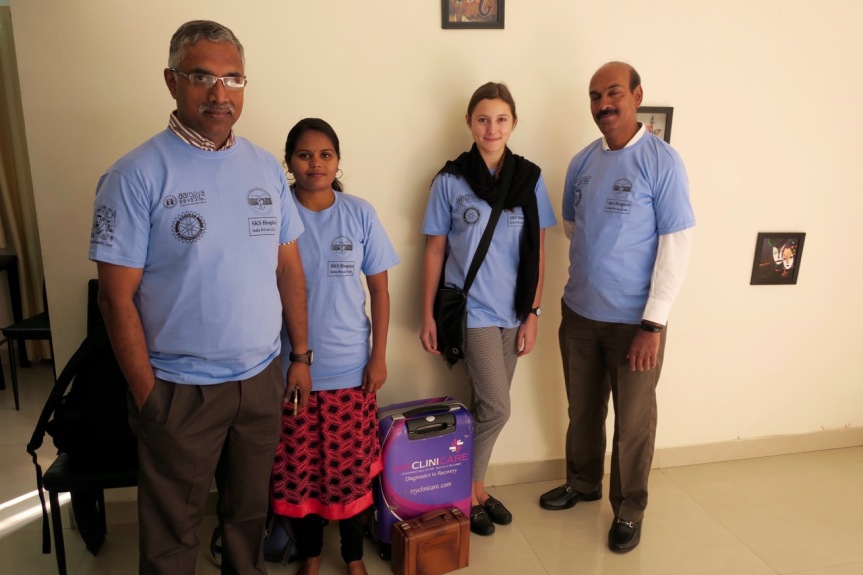
IMG_3728.jpg
The MyCliniCare team and me in our volunteer t-shirts! The MyCliniCare suitcase is in the shot as well.
IMG_3743.jpg
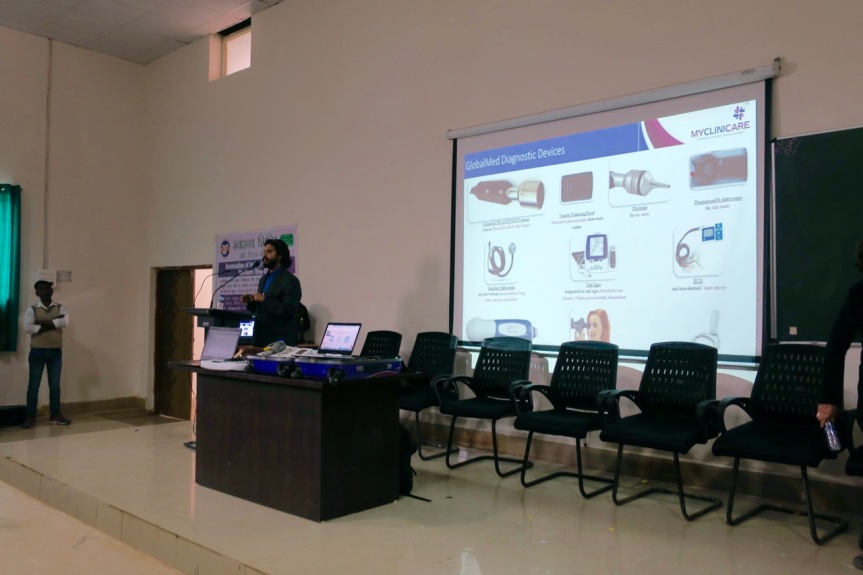
Dr. Dayaprasad, founder and director of the Aarogya Seva foundation, giving a presentation to medical students in Bhopal about the various medical diagnostic devices included in the MyCliniCare telemedicine kit.
IMG_3746.jpg
Here, Gururaja of MyCliniCare is demonstrating the telemedicine setup by pointing the multipurpose otoscope into his mouth. The resulting image of his throat is displayed on the projection screen, which is what a doctor would see remotely.

One new addition to MyCliniCare’s set is the iBreastExam device, a handheld sensor for breast tumor screening. Using piezoelectric sensors, the device checks for lumps in a patient’s breasts and delivers a result in 5-10 minutes; if it finds anything, a mammogram follow-up is required. In each village that we visited, the MyCliniCare team set up a private place for their technician to screen women with iBreastExam.

IMG_3839.jpg
The iBreastExam handheld device is pink and white, and it delivers real-time results to the connected app.
IMG_3832.jpg
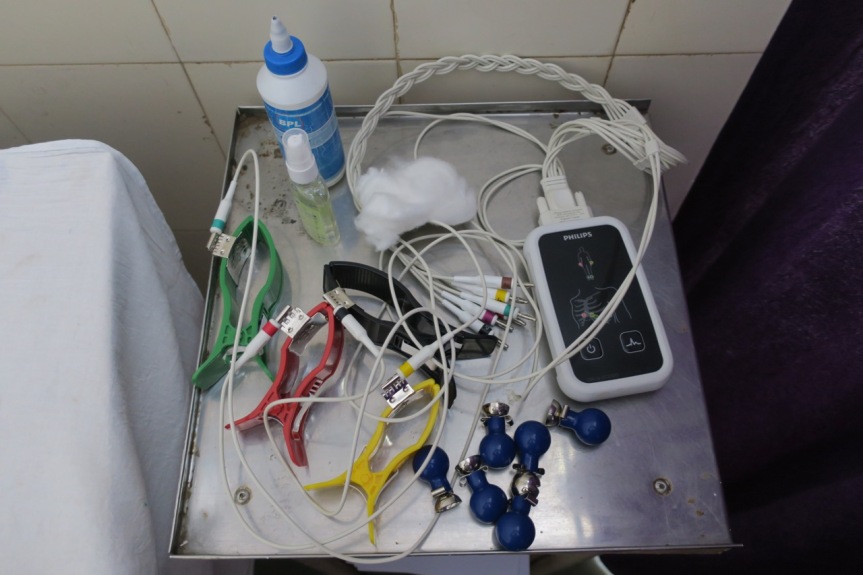
In the same room as the breast tumor screening, we performed ECGs with this portable device (which also sends its results to a smartphone app, connected via WiFi).

Though I initially intended to tag along with the MyCliniCare team and simply observe, I ended up becoming a full volunteer for a few days since the health camp needed the help. For the first two days, I teamed up with a doctor to run the blood-test station. The doctor spoke to the patients in Hindi and pricked their fingers to get blood, and I took the samples and ran the tests with the devices we had brought. We had a small hemoglobin device to test for anemia and a small glucometer to test for high blood sugar.

IMG_3782.jpg
The HemoCue hemoglobin meter that we used. Incidentally, it is made by a Swedish company!
IMG_3784.jpg
Medicines set up by the pediatricians in the same room as the blood testing.

After months of interviewing people about attitudes towards health and medical technology in rural India, it was invaluable to see those very attitudes in front of me. It felt like all of a sudden I had gone from using secondary sources for my information to primary sources. Most of the villagers were comfortable getting their blood drawn and tested, as it was a simple and quick procedure that was explained to them in Hindi. However, they rarely reacted to the results due to a general lack of awareness of how much blood sugar was too much and what that meant, as well as what the purpose of hemoglobin testing was.
A few of the villagers, especially the children, were scared to get their fingers pricked and found it quite painful (making very familiar cringing faces!). One woman in the village of Tumda sat down for a blood test, had her finger swabbed with alcohol, took one look at the little lancet that was about to pierce her fingertip, and started cursing in Hindi and nearly ran out the door. I was stunned that she hadn’t realized what a blood test entailed. Her reaction reminded me of a few interviews I’ve had here in which people have told me that many Indian patients, especially in rural areas, are resistant to invasive procedure from finger-pricking to surgery.
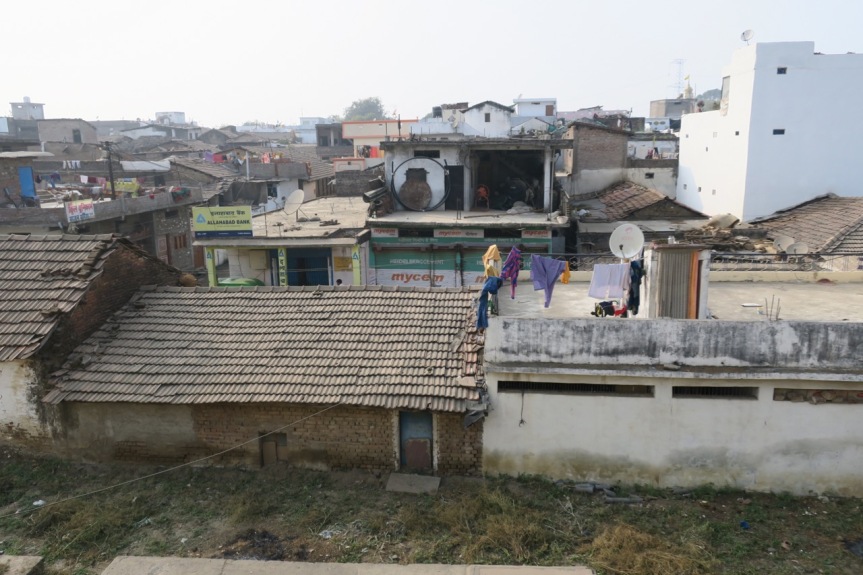
IMG_3815.jpg
Tumda Village.
IMG_3823.jpg
As things quiet down in Tumda, the volunteers show each other how to read a classic blood pressure monitor.

As part of the camp, I traveled to the villages of Seoni, Tumda, and Berasia. I was happy that my fellow volunteers were mostly Indian; I wonder if the villagers were a bit put off by my presence (being an obvious foreigner), and it was challenging not knowing Hindi. So it was good to stay useful, and it was fascinating for me to be around so many doctors volunteering their services. Of course, the question of sustainability is always important: how do these one-off health camps help the villagers if we can’t come back to the village? The doctors I asked told me that some care is always better than no care, and the big problem is awareness – many villagers are not aware of their medical issues or how to address them. At least with a visit from specialists via this type of health camp, patients can get the right information and seek the appropriate care at a more accessible (and permanent) health center or hospital. The Medical Yatra team keeps track of all the patients that need to be referred to specific hospital departments, and they send those lists to the nearby hospitals, who then send vans to the villages to pick up the patients for free treatment at their facilities. Also, most patients do have a mobile number, so we can at least call to follow up.

IMG_3772.jpg
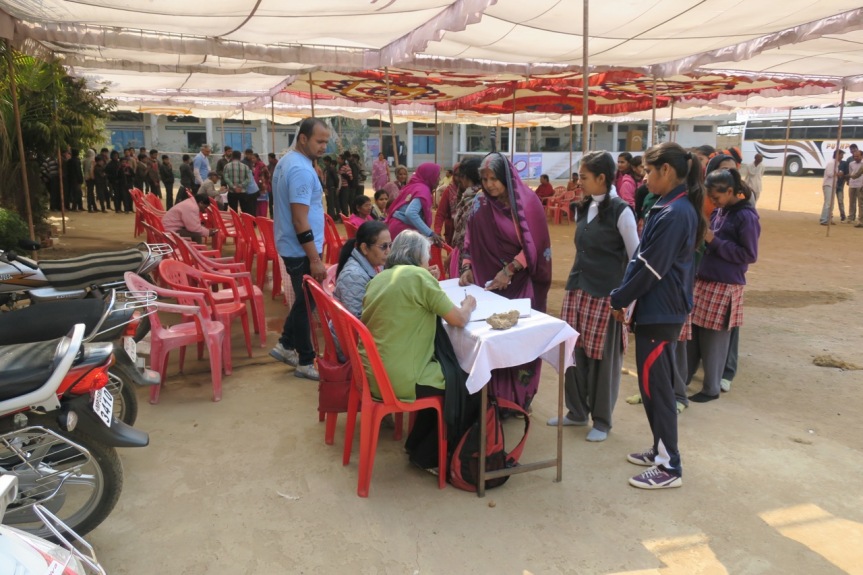
The school in Seoni where we set up camp.
IMG_3778.jpg
Medical Yatra volunteers registering patients for treatment.
IMG_3760.jpg
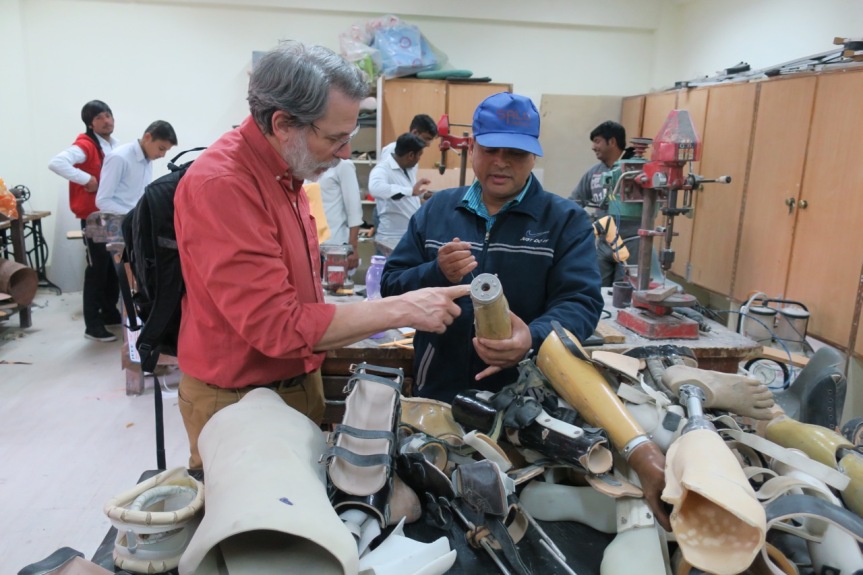
In Bhopal, we visited this government center making prosthetic limbs and offering rehabilitation techniques. Professor Schull, on the left, was interested in comparing their design to his 3D-printed prosthetic designs.
IMG_3790.jpg
One of Professor Schull’s 3D-printed prosthetic prototypes.
IMG_3840.jpg
The internal medicine room that we set up at Berasia village. The hallway just outside the room was packed wall-to-wall with patients all day.
IMG_3841.jpg
Dr. Ramesh Shah, a volunteer from Ohio.

I’m very grateful to MyCliniCare and the Aarogya Seva foundation for letting me join their effort for a few days. It was inspiring to meet so many hard-working doctors and actually operate the type of medical devices I’ve been thinking about throughout my project.

Monday, April 25, 2016

Justin Kochanski, USA - 6 April - 18 May 2016

I graduated from Drake University in Des Moines, Iowa this past May. Originally from Chicago, IL, I attended university to study Biochemistry, Cell and Molecular Biology with a concentration in Global and Comparative Public Health. I've worked many odd jobs to help pay for school– pathology technician, oncology laboratory assistant, and junior epidemiologist at the state department, just to name a few. 

My experience from these jobs, along with my compassion for social justice and philanthropy, has led me to pursue a career in medicine. I will start medical school this coming August, with the intent of working in some sort of global health setting after graduation. I strongly believe that health is a fundamental human right, and I want to work to help secure and promote that right throughout the world. 

Seva to me means "A commitment to humanity and dedication to justice, pursuing what is just."

When I am not studying, you can find me on the soccer pitch, rock climbing, or backpacking!

Sunday, February 7, 2016

2016 AIPNO Medical Yatra


As was previously noted, Aarogyaseva was again part of 2016 Medical Yatra in Gujarat which ran from 23rd January to 30th January in connection with the following organisations
  • Association of Indian Physicians of Northern Ohio (AIPNO)
  • Action Research in Community Health (ARCH)
  • Rotary Club of Dharampur 
  • Shabri Chhatralaya
  • Intal

It brought 37 both medical professionals and general volunteers from USA, UK, India and Australia in conjunction with local health workers, Rotarians and ARCH workers.  We had with us a mix of internal/family doctors, emergency physicians, paediatricians, obstetrics/gynaecologists, dentists and an orthopaedic surgeon.  Apart from seeing the patients we also conducted CPR and dental hygiene education sessions as well as have patients take part in blood pressure research.


AIPNO was founded in 1983 and is a non-profit membership organisation of physicians of Indian origin in Northern Ohio. It has membership of 300 physicians and have they organised Medical Yatras since 2001.  They have provided aid to Mexico, Haiti, Peru, Ecuador, Uganda, Kenya, Honduras, Dominican Republic, Burundi and India. What is amazing is that the volunteers who came were in the late 60s and 70s who were either semi retired or retired.  Visit their website http://www.aipno.org/ for more information

ARCH currently provides provides primary health care services to approximately 25,000 patients along with basic health education and preventative services such as vaccinations and prenatal care. In addition they provide movie health camps in surrounding villages.  More about them can be found here: http://www.archgujarat.org/ 

We were split into 2 groups each visiting 5 locations over 5 days seeing up to 1,000 patients daily and ~4,000 patients in total. (The exact numbers are still to be finalised.)  People came from nearby villages and waited patiently for several hours to be seen. At each spot we spent 4-8 hours depending on the number of patients that presented.   For some of us we stepped into unfamiliar roles of dental, paediatric, gynaecology or pharmacy assistants, whilst others had to recall prior knowledge to diagnose, prescribe and dispense medications.   All of us had to improvise with limited supplies and diagnostic tools whilst working in a team to provide the best possible outcome.

Each stop was unique with a different variety of diagnosis and facilities. On some days it took us only about 30 minutes to get there and on others over 90 minutes across dirt roads. The majority of time we were situated within the local school which meant the kids had a disruptive day and were free to interact with the group, be seen by paediatricians or dentists and/or attend educational sessions being run. Regardless of where we were, the locals were all very welcoming and patient. It was heartwarming to see some of the older children assist with translation, directing people and/or helping the older patients to where they needed to go. 


Undernutrition was massive problem with 14-16 year old teenagers looking like they were 9-10 years old. The adults on the other hand looked much older than they should be due to physical outdoor labour with in many cases extremely high blood sugars and blood pressures. 

Language was a massive issue with local tribal languages being spoken in many instances as opposed to Gujarati or Hindi which become a case requiring up to 3 interpreters sometimes depending on the translator and Doctor.   


Observations

  • all who came were strong, happy and didn’t complain about the wait or their lot in life with physical examinations easy due to the lack of fat (many of those in their 40s/50s had six pack abs!) 
  • Biggest issues were undernutrition, undiagnosed hypertension, diabetes, goitres, cataracts, dry skin and cavities 
  • Introduction of fluoride, reduced salt and sugar diets and iodised salt would greatly assist these communities as part of preventable health schemes  
  • Girls were particularly shy with all being curious particularly around the tall Americans, our smart phones and cameras 
Outcomes from 2016 Medical Yatra
  • Recommendations to reduce cavities and improve teeth health particularly in children to be provided to local government officials 
  • ARCH has committed to follow up patients seen including scheduling of 33 cataract surgeries 
  • A piece for AJ+ (on online news and current events channel by Al Jazeera Media Network AJMN) is being finalised.  


All of us came with open hearts, warm smiles, positive and flexible attitudes and a sense of humour but left with so much more.  We have much to learn from each other and language is not a barrier.


I would highly recommend going on Medical Yatra as it is so much more than volunteering with an amazing bunch of people and seeing the countryside and interacting with the locals in a unique way as it includes component of spirituality as we stayed at Shrimad Rajchandra Mission Dharampur and were even fortunate enough to have an audience with Baba Pujya Gurudevshri Rakeshbhai.  More about the Ashram and their work is here: http://www.shrimadrajchandramission.org/

More photos are available here: https://www.facebook.com/media/set/?set=a.1582019118687142.1073741860.1384301005125622&type=1&l=4335feceba 

Number of Doctors: 14 including 2 dentists
Total number of volunteers: 37
Number of patients seen: ~4000
Number of sites visited: 10 

Volunteer hours (based on average 6 hour day for 37 volunteers) : 1110 hours


Sunday, January 31, 2016

Wendy Chan - Introductory Post

Namaste.

My name is Wendy Chan and you’ll be hearing from me over the next 6 months.

It is my first time to India and so far I’ve found Bangalore a vibrant, friendly and beautiful city.  I am looking forward to being immersed in the various different cultures, spices and contrasts and contradictions that is India. Above all I am really excited to be doing a 6 month internship here with AarogyaSeva as part of my 6 month IDEX Global Fellowship Program.   

The IDEX Global Fellows program is a 6 month curriculum filled with curated readings, professional development assignments and workshops, one on one mentoring and coaching as well as a placement in local organisation. IDEX’s mission is to create the next wave of individuals who will innovate, develop and promote solutions to social challenges within an existing enterprise or organisation. To find out more please head to: http://www.idexfellows.com/

There are 14 other fellows as part of my cohort at IDEX this year and they have been placed with a diverse range of organisations such as Ashoka, LabourNet, Wings and Shenomics. I’m hoping we can leverage off these networks for some mutually beneficial outcomes.  Last week we were given the opportunity to settle into our new city, get to know each other and hear from a diverse range of speakers.  One of the highlights was our visit to AMBA.

AMBA provides training to the intellectually challenged so that they can be employed to do back office data entry jobs. This brings life changing fulfillment and economic empowerment to the individuals and reduces the economic burden on their families.  Further to that, AMBA provides free training to organisations that would be keen to empower intellectually challenged in their local communities. To date they there are 105 AMBA partners spanning 17 states, impacting over 3,200 intellectually disabled adults and growing.  If you know of anyone with data entry work or would be keen to get in touch with AMBA let me know.  Otherwise to find out more please head over to their website: http://www.ambaforlife.org/

So a little about me, I’m originally from Hong Kong though as I grew up in Australia I do associate myself as an Aussie.  Still I think my Chinese heritage has deeply influenced my perspective. I was most recently working in Banking where I helped managed a portfolio of both small enterprises and large multinational corporates customers from a diverse range of industries including but not limited to retirement and aged care operators, car dealerships, label manufacturers and property investors.  Prior to that I was previously a pharmacist and so have an understanding of the dynamics and challenges of providing healthcare to the community.  

During my time at AarogyaSeva I’m looking to increase brand awareness particularly via social media, grow the AarogyaSeva Student Chapter and help coordinate various other activities and initiatives.  I am looking forward to meeting the team and engaging with AarogyaSeva supporters.

We are open to suggestions, ideas and feedback so please feel free to drop us a line.

Disclaimer: The opinions expressed within this article are the personal opinions of the author. The facts and opinions appearing in the article do not reflect the views of AarogyaSeva and AarogyaSeva does not assume any responsibility or liability for the same.
To get in touch with the author or to join our team write to us at – Volunteer@aarogyaseva.org

Wendy Chan, Australia - 11 January 2016 - 11 July 2016

Wendy
 Wendy Chan has joined us as part of the January 2016 IDEX  fellowship. The IDEX Global Fellows program is a 6 month  curriculum filled with curated readings, professional  development assignments and workshops, one on one  mentoring and coaching as well as a placement in local  organisation. IDEX’s mission is to create the next wave of    individuals who will innovate, develop and promote solutions to  social challenges within an existing enterprise or organisation.
 Wendy is originally from Hong Kong though has spent most of  her time growing up in Brisbane Australia.  She has over 5 years  experience in banking looking after the requirements of both  family owned and multinational listed corporations. Prior to  this she was a registered pharmacist with close to 7 years experience in the community setting. She holds a Bachelor of Pharmacy and a Masters of Commerce Adv (Accounting) from the University of Queensland.
During her time with AarogyaSeva Wendy is seeking to increase our brand awareness and interactions with supporters particularly via use of social media.  She will regularly update the blog, look to engage and build AarogyaSeva student chapters whilst also helping out where she can.
Wendy can be reached at Wendy@aarogyaseva.org

Sunday, December 6, 2015

Annelies - Blog Week 4


 The time flies here in India. It is already the last week of my internship. The last week I spent my time on the Cosmetic Dermatology department. This department has a lot of similarity to the treatments of the Skin Therapist in the Netherlands. The Skin Therapist is in the Netherlands furnished to have a collaboration with the (para)medical disciplines in particular the Dermatologist. As I described before, Skin Therapy is very unknown around the world. In the collaboration between the skin therapist and the Dermatologist, the Dermatlogist mainly sees cases such as acne, excessive hair growth, chemical peelings, microderm abrasion, camouflage, laser treatment, micro needling to the Skin Therapist. Skin therapists can treat up to a certain depth into the skin and if the case does not belong to their knowledge, it is forwarded to the dermatologist, or another professionals. It was good to see the similarities of treatments, but also the different ways of treating the cases. I have learned a lot about different scar treatment techniques. What is known about scars is that the treatment is complex, especially the deeper scars. I can take it with me in the work field of the skin treatment in The Netherlands or  in other places where they do not use this techniques yet.

What I really like at the internship in India was to learn more of the treatment of the colored (pigmentation) skin, the different healthcare system compared to the western world, and the diversity of cases. I saw many cases I had previously only seen in pictures. But it was all above the whole experience.

Showing translation for ik denk dat het een goede
Translate instead ik denk dat het een gode

I think it's a good addition to my professional experience, but also to my professional development by seeing different cultures and lifestyles. But it is not the end of my ‘abroad experience’. The next destination is Nepal. I am going to do two weeks of volunteering for the victims of the earthquake. 


Disclaimer: Annelies is a native Dutch speaker. This article has not been edited for either content or grammar.  The opinions expressed within this article are the personal opinions of the author. The facts and opinions appearing in the article do not reflect the views of AarogyaSeva and AarogyaSeva does not assume any responsibility or liability for the same.


To get in touch with the author or to join our team write to us at – Volunteer@aarogyaseva.org

Monday, November 30, 2015

Annelies - Blog Week 3

The context of this week was the international conference in Mysore. The 4 days were all about the gender equity: social issues and health challenges in today’s context. The international conference was on the university of Mysore. The first day was all about transgender issues. The special was that there were 3 speakers who have to deal with the transgender issues. They shared their experiences and this made the topic more empathetic and they put some power behind it.
The next day came there 3 other speakers of Aarogyaseva. They made a movie about transgenders and showed the life here in India trough they eyes. Near the movie was a powerful speech. This was a good combination which held the attention of the public.
On this conference i saw a lot of presentations and i met people from all over the world, but i didn’t only listen, i presented my topic as well. The skin therapist is very unknown around the world. This conference was a good opportunity to make the change in this. The presentation was about the profiling of the skin therapist. I shared my experiences of the healthcare in India. I told them about the treatments we do and what we could mean for the healthcare. Even in the Netherlands is the skin therapist not very well known. It was a pleasure to do a presentation on this conference. I was a little nervous, but after the presentation i was glad i did it!

Next week i will observate the cosmetic department of the dermatology. That is already the last week in India, but fortunately, it is not the end of my volunteer experience, then I'm going to Nepal to volunteer two more weeks!

Disclaimer: Annelies is a native Dutch speaker. This article has not been edited for either content or grammar.  The opinions expressed within this article are the personal opinions of the author. The facts and opinions appearing in the article do not reflect the views of AarogyaSeva and AarogyaSeva does not assume any responsibility or liability for the same.

To get in touch with the author or to join our team write to us at – Volunteer@aarogyaseva.org

Sunday, November 29, 2015

Annelies - Blog Week 2

The time goes very fast here in India. I finished already the second week of my internship. This week was very varied. The first three days were at the dermatology department. I saw here different cases and treatments. Among other skin cancers, hair transplantation, the injection of scars, the removal of cysts. It was very interesting. Also i followed a college about injectables and about fat transplantation. The hair transplantation treatment lasted ten hours. I was allowed to assist with the cutting of the hairs from the proper tissue that had been removed from the occiput.

The theme of the other three days was the Indian Inclusion Summit event in Bangalore and the project of Professor Luis Columna from the USA. He showed his program for physical activity for children with disabilities. He gave a presentation at the Bangalore Medical college. Also we went to organizations for children with disabilities and next year he want to come with his students to India to start the program. Hopefully i am in the possibility to help out with the program and to learn more about this field of the healthcare.
On saturday we went to the Indian Inclusion Summit event. The combination of presentations of people with disabilities and medische disciplines was very interesting. There were very inspirating stories. I like to see the powerful stories of the strong people. They have a great perseverance to pursue the quality of life as good as possible.

This was my blog of my second week here in India. Next week i go to Mysore for an international conference. I will give here a presentation about the profession skin therapist.

Disclaimer: Annelies is a native Dutch speaker. This article has not been edited for either content or grammar.  The opinions expressed within this article are the personal opinions of the author. The facts and opinions appearing in the article do not reflect the views of AarogyaSeva and AarogyaSeva does not assume any responsibility or liability for the same.
To get in touch with the author or to join our team write to us at – Volunteer@aarogyaseva.org