Showing posts with label Health care. Show all posts

Friday, March 17, 2017

Mercer Borris shares her experience


Health post: Medical Camps in Rural Villages


(as posted originally in https://interfacesofhealth.wordpress.com/2017/01/24/health-post-medical-camps-in-rural-villages/)

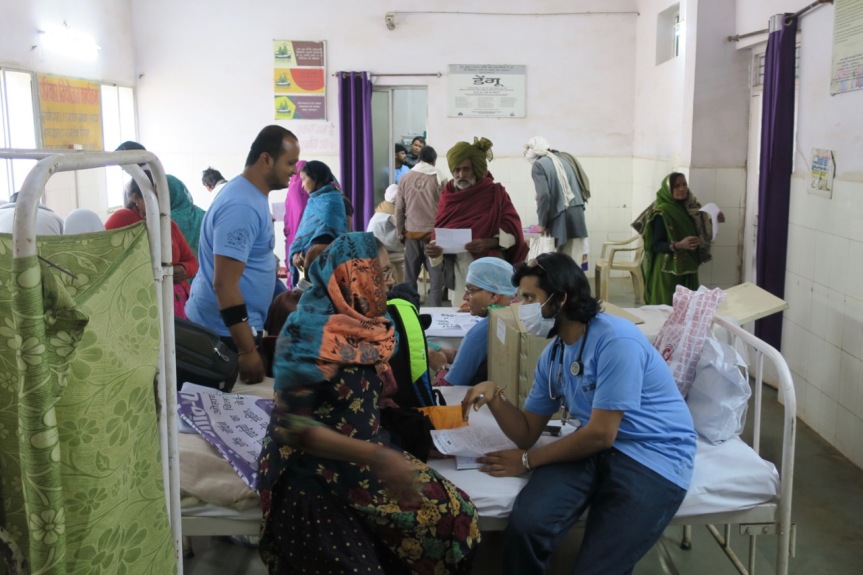
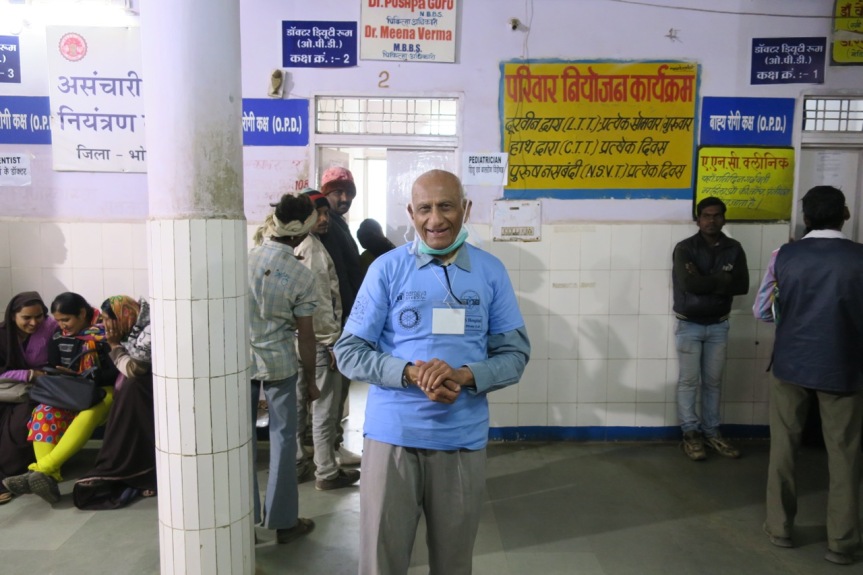
Last week I traveled to Bhopal, the tier-two capital city of Madhya Pradesh, a state in central India. I was there to participate in a health camp called Medical Yatra, which is an annual event to bring healthcare services to rural villages across the country. Each year, the Medical Yatra team convenes in a new city and spends ten days traveling out to neighboring villages. It’s a joint effort by an association of India physicians of Northern Ohio, local hospitals, the non-profit foundation Aarogya Seva, and the Rotary International club (http://www.aarogyaseva.org/medical-yatra-2017/).

IMG_3825.jpg
Aarogya Seva’s slogan is “Promoting Healthcare Volunteerism.” While I wasn’t planning on doing any volunteering on the Watson, I felt humbled to be included in the group and able to contribute in some way.

I heard about the camp because a company I interviewed for the project, MyCliniCare, was going to attend for a few days to bring their technology along with the medical supplies. MyCliniCare provides a telemedicine solution in the form of a suitcase for on-the-go healthcare. The suitcase, which can be brought to any rural area, has many small medical devices and monitors along with a laptop that synthesizes the collected data and connects to a trained doctor over a video call.
IMG_3728.jpg
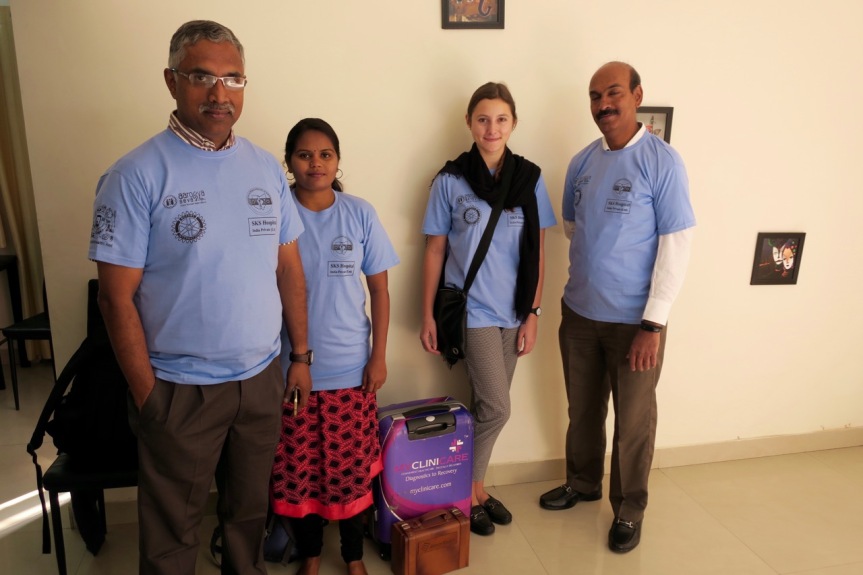
The MyCliniCare team and me in our volunteer t-shirts! The MyCliniCare suitcase is in the shot as well.
IMG_3743.jpg
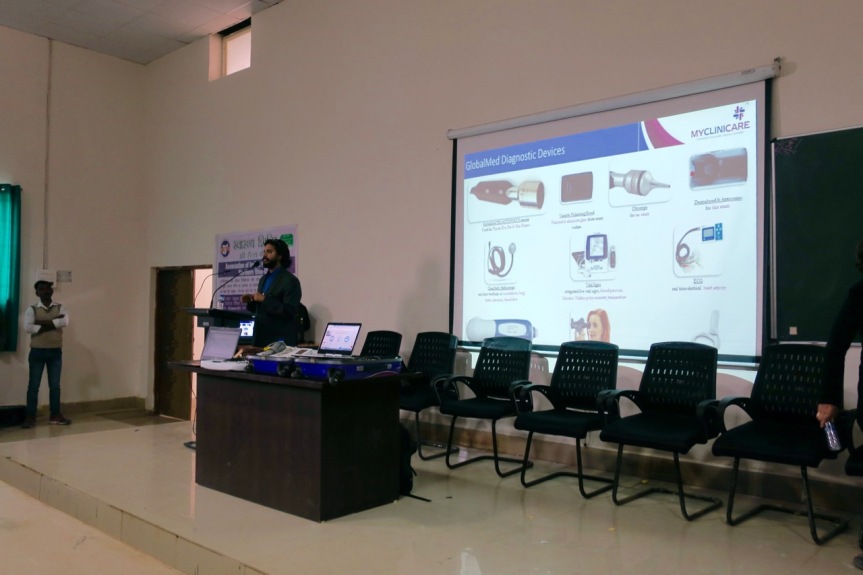
Dr. Dayaprasad, founder and director of the Aarogya Seva foundation, giving a presentation to medical students in Bhopal about the various medical diagnostic devices included in the MyCliniCare telemedicine kit.
IMG_3746.jpg
Here, Gururaja of MyCliniCare is demonstrating the telemedicine setup by pointing the multipurpose otoscope into his mouth. The resulting image of his throat is displayed on the projection screen, which is what a doctor would see remotely.

One new addition to MyCliniCare’s set is the iBreastExam device, a handheld sensor for breast tumor screening. Using piezoelectric sensors, the device checks for lumps in a patient’s breasts and delivers a result in 5-10 minutes; if it finds anything, a mammogram follow-up is required. In each village that we visited, the MyCliniCare team set up a private place for their technician to screen women with iBreastExam.

IMG_3839.jpg
The iBreastExam handheld device is pink and white, and it delivers real-time results to the connected app.
IMG_3832.jpg
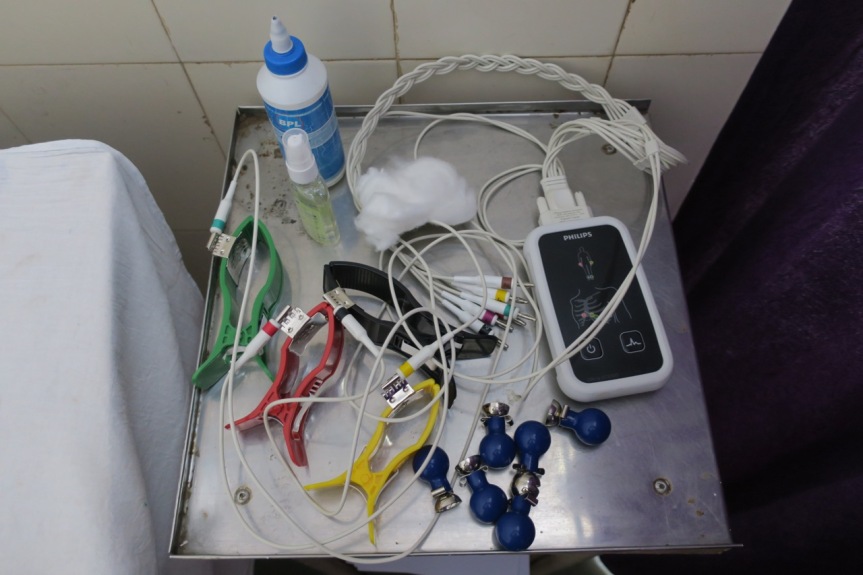
In the same room as the breast tumor screening, we performed ECGs with this portable device (which also sends its results to a smartphone app, connected via WiFi).

Though I initially intended to tag along with the MyCliniCare team and simply observe, I ended up becoming a full volunteer for a few days since the health camp needed the help. For the first two days, I teamed up with a doctor to run the blood-test station. The doctor spoke to the patients in Hindi and pricked their fingers to get blood, and I took the samples and ran the tests with the devices we had brought. We had a small hemoglobin device to test for anemia and a small glucometer to test for high blood sugar.

IMG_3782.jpg
The HemoCue hemoglobin meter that we used. Incidentally, it is made by a Swedish company!
IMG_3784.jpg
Medicines set up by the pediatricians in the same room as the blood testing.

After months of interviewing people about attitudes towards health and medical technology in rural India, it was invaluable to see those very attitudes in front of me. It felt like all of a sudden I had gone from using secondary sources for my information to primary sources. Most of the villagers were comfortable getting their blood drawn and tested, as it was a simple and quick procedure that was explained to them in Hindi. However, they rarely reacted to the results due to a general lack of awareness of how much blood sugar was too much and what that meant, as well as what the purpose of hemoglobin testing was.
A few of the villagers, especially the children, were scared to get their fingers pricked and found it quite painful (making very familiar cringing faces!). One woman in the village of Tumda sat down for a blood test, had her finger swabbed with alcohol, took one look at the little lancet that was about to pierce her fingertip, and started cursing in Hindi and nearly ran out the door. I was stunned that she hadn’t realized what a blood test entailed. Her reaction reminded me of a few interviews I’ve had here in which people have told me that many Indian patients, especially in rural areas, are resistant to invasive procedure from finger-pricking to surgery.
IMG_3815.jpg
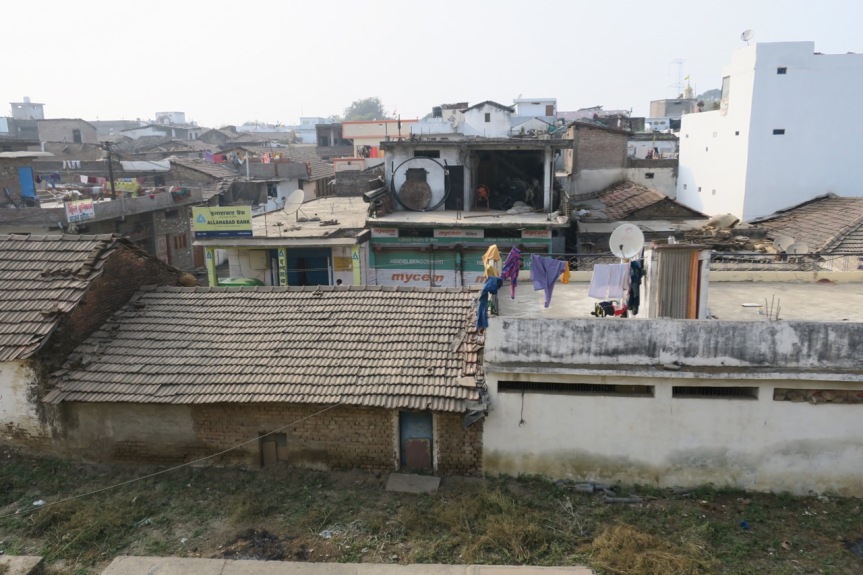
Tumda Village.
IMG_3823.jpg
As things quiet down in Tumda, the volunteers show each other how to read a classic blood pressure monitor.

As part of the camp, I traveled to the villages of Seoni, Tumda, and Berasia. I was happy that my fellow volunteers were mostly Indian; I wonder if the villagers were a bit put off by my presence (being an obvious foreigner), and it was challenging not knowing Hindi. So it was good to stay useful, and it was fascinating for me to be around so many doctors volunteering their services. Of course, the question of sustainability is always important: how do these one-off health camps help the villagers if we can’t come back to the village? The doctors I asked told me that some care is always better than no care, and the big problem is awareness – many villagers are not aware of their medical issues or how to address them. At least with a visit from specialists via this type of health camp, patients can get the right information and seek the appropriate care at a more accessible (and permanent) health center or hospital. The Medical Yatra team keeps track of all the patients that need to be referred to specific hospital departments, and they send those lists to the nearby hospitals, who then send vans to the villages to pick up the patients for free treatment at their facilities. Also, most patients do have a mobile number, so we can at least call to follow up.

IMG_3772.jpg
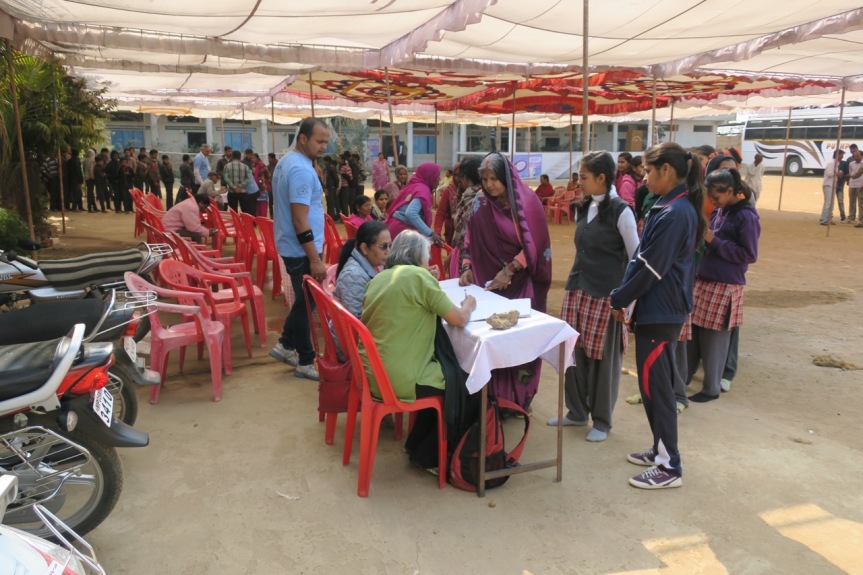
The school in Seoni where we set up camp.
IMG_3778.jpg
Medical Yatra volunteers registering patients for treatment.
IMG_3760.jpg
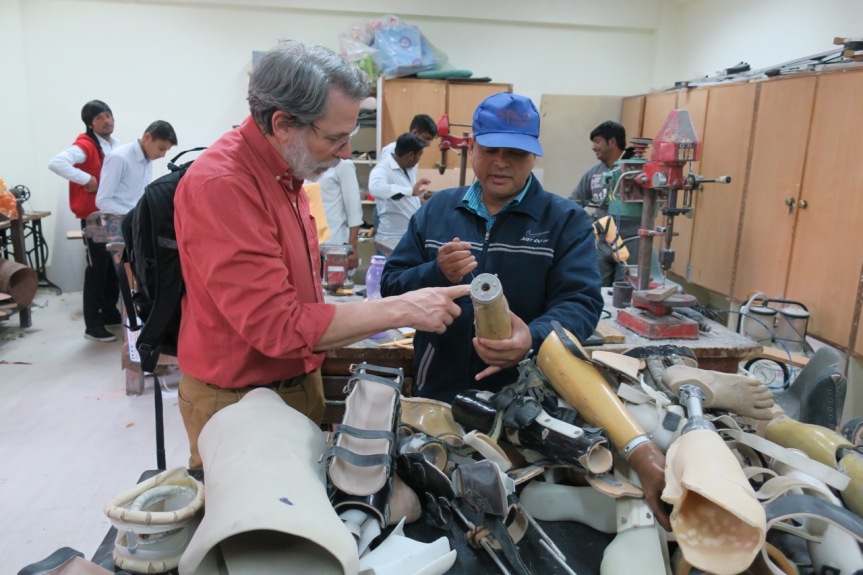
In Bhopal, we visited this government center making prosthetic limbs and offering rehabilitation techniques. Professor Schull, on the left, was interested in comparing their design to his 3D-printed prosthetic designs.
IMG_3790.jpg
One of Professor Schull’s 3D-printed prosthetic prototypes.
IMG_3840.jpg
The internal medicine room that we set up at Berasia village. The hallway just outside the room was packed wall-to-wall with patients all day.
IMG_3841.jpg
Dr. Ramesh Shah, a volunteer from Ohio.

I’m very grateful to MyCliniCare and the Aarogya Seva foundation for letting me join their effort for a few days. It was inspiring to meet so many hard-working doctors and actually operate the type of medical devices I’ve been thinking about throughout my project.

Sunday, July 3, 2016

Aditi Sriram, Chennai, India - Summer 2016

"My name is Aditi. I have completed my engineering in Biotechnology and I'm all set to begin my Master's in Public Health at the University of Massachusetts- Amherst this Fall. That young minds are impressionable, is well-established and in my case the impressions of my childhood are a large part of the reason I put pen to paper today. In retrospect, growing up around my father's brother –a para medical officer at the Indian Council of Medical Research – has had a significant influence on my outlook to life. My uncle dedicated himself to the eradication of leprosy.  As part of his job, he would visit countless villages leading a crusade against leprosy and the stigmatization suffered by those who suffer from it, infallibly returning home with fruits to eat and endless stories that invariably involved changing people’s lives for the better. At that age, I could only grasp a fraction of what he did, and only got a sense of the number of lives he had touched at his funeral procession, where a huge number of his patients and colleagues turned up – mourning like they had lost one of their own. Through my uncle's example, I learnt that leaders have a bias for action. They invest themselves fully into their people and purpose, knowing that in the long run, all the time and energy will be worth it. This is exactly what I am looking to take back from my internship at Aarogya Seva.  Added to this, I will have the chance to interact with a group of extremely dedicated people from all backgrounds, majors and experiences. I’m sure the experience will be meaningful and humbling. "

Saturday, July 2, 2016

Ishil Puri, California, USA - Summer 2016

Ishil is a 10th grader attending high school in the Bay Area. He started programming in 7th grade and has loved it ever since. He has made a few games and apps and has programmed for his robotics team, but wanted to make a bigger impact on the people of the world. He has also had an interest in Health science and has been the officer the HOSA health club at his school since middle school. He is excited to work as an intern for Aarogya Seva so he can apply both of his passions towards a cause that will benefit millions of people.

Thursday, June 23, 2016

Thank you from Wendy IDEX fellow


I was placed with Aaorgayseva as part of my 6 month IDEX fellowship.  Time has flown so quickly.   When I first came I thought there would be so much time to do so many things.  Yes we did achieve a lot during my time here though there is still much to be done.

The highlight of my time here was having the opportunity to join the 2016 AIPNO Medical Yatra.  It was a different way to see the country, meet the locals and make new friends.  It was an unforgettable time where we all had to be flexible, creative and patient with limited supplies and language barriers. The thing about the Yatra is that it is not just about going out there and helping community it also included a visit to a girls boarding school, a women's empowerment project and Republic Day Festivities whilst staying in an Ashram. The other volunteers were an inspiration especially given that large majority were in their late 60s and had been doing this for the past 10 years and will continue to do so as long as they are able. 


I am really proud that I took the leap to come to India.  To anyone considering a move from what they know I certainly say do it.  I feel that unless and until you challenge yourself and do what you fear you don’t really give yourself a chance to learn, grow and really know who you are.  It is in those times of worries and insecurity we realise just what is most important to us.  

I would like to take this opportunity to thank everyone for their warm hospitality and hope that our paths will cross again. I look forward to being updated on what Aarogayseva is doing both in India and around the world. 


Disclaimer: The opinions expressed within this article are the personal opinions of the author. The facts and opinions appearing in the article do not reflect the views of AarogyaSeva and AarogyaSeva does not assume any responsibility or liability for the same.


To get in touch with the author or to join our team write to us at – Volunteer@aarogyaseva.org


Thursday, June 16, 2016

Charanya Kaushik, USA 23 May - 20 July 2016


Charanya is pursuing an MPH in Epidemiology at UTHealth in Houston, Texas. Her research interest focuses on improving healthcare access and quality for underprivileged populations. Prior to starting her MPH program, she taught high school chemistry and coached tennis with Teach for America in Harlingen, Texas. A Native of Pittsburgh, PA, Charanya graduated from Washington and Jefferson College with a double-major in Cell & Molecular Biology and Spanish. Charanya will work with Aarogya Seva for two months to investigate TB and HIV co-infection at Accept, a HIV care center on the outskirts of Bangalore.

Monday, June 13, 2016

World Blood Donor Day 14th June


This year's the theme is “Blood Connects us all”.


WHO began celebrating World Blood Donor day in 2004 to 
  1.  recognise and thank blood donors around the world
  2. raise awareness on the need for safe blood and blood products 

June 14th was chosen as World Blood Donor Day to recognise birthday anniversary of Karl Landsteiner. 

Karl Landsteiner

Karl Landsteiner is an Austrian American biologist and physician who won the 1930 Nobel Prize in Physiology or Medicine for his discovery of human blood groups.   However this is not his only contribution to medicine, Karl Landsteiner working with Constantin Levaditi and Erwin Popper discovered the polio virus in 1909. His Nobel Prize award ceremony speech can be found here: here .

Interestingly, there are stark differences in who receives donations in different countries - 76% of all transfusions in high income countries go to those over 65 years whilst 65% of donations in low income countries are given to children under 5.


For high income countries blood transfusions are used for massive trauma, supportive care in cardiovascular and transplant surgeries and in the treatment of solid and haematological malignancies.   Pregnancy related complications, childhood malaria complicated by anaemia and trauma are the most common reasons for blood transfusions in low and middle income countries. 

As voluntary unpaid donors have the lowest prevalence of blood borne infections adequate and reliable supply of safe blood needs to be from a stable base of regular, voluntary unpaid blood donors.  Though 73 countries collect 90% of their blood from this source 72 countries still collect more than 50% of their supply from family/replacement or paid donors. 


Some other facts about blood donations
  • Blood donation by 1% of the population can meet a nation’s most basic requirements for blood
  • 62 countries collect 100% of their blood supply from voluntary unpaid blood donors
  • Blood donation rates vary from 3.9 donations per 1000 population in low income countries to 36.8 donations in high income countries 
  • 108 million blood donations are collected globally every year with only 50% from low and middle income countries where 80% of the population lives 
  • Unfortunately there are still 25 countries who are not able to screen all donated blood for HIV, hepatitis B and C and syphilis prior to transfusions 
  • Blood can be separated into various components to benefit several patients 

So on World Blood Donor Day please share life and give blood.


Disclaimer: The opinions expressed within this article are the personal opinions of the author. The facts and opinions appearing in the article do not reflect the views of AarogyaSeva and AarogyaSeva does not assume any responsibility or liability for the same.

To get in touch with the author or to join our team write to us at – Volunteer@aarogyaseva.org


Sunday, June 12, 2016

International Albinism Awareness Day 13/6


"There is no room in this 21st century for erroneous and harmful beliefs, or for discrimination on any grounds. People with albinism are just as deserving of dignity as every other human being. They have the right to live free from discrimination, deprivation and fear."
ZEID RA'AD AL HUSSEINUN High Commissioner for Human Rights


June 13th 2015 was the first time International Albinism Awareness Day was celebrated. This came about through active campaigning from various organisations and the increased violent attacks on persons with albinism particularly in Africa. 

To see a moving story go here:

It is noted however that this is not an isolated condition for this region.  

Albinism results in lack of melanin pigment in the hair, skin and eyes causing increased sensitivity to the sun and also visual impairments.  It is an inherited rare non contagious genetic disease which occurs worldwide regardless of background and gender.   Exact data on prevalence is uncertain unfortunately partly due to the stigma and discrimination faced.


To see the Message by the UN High Commissioner for Human Rights Zeid Ra'Ad Al Hussein:


This quote from Zeid Ra'Ad Al Hussein speech highlights the challenges: 

"In some parts of the world, people with albinism may also suffer horrific, and sometimes lethal, atrocities. Civil society activists have reported that hundreds of people with albinism – a majority of them children – have been killed, mutilated or otherwise attacked in at least 25 African countries, because of the belief that their body parts confer magical powers. More cases remain undocumented because of the isolation of the victims, the secrecy surrounding ritual practices, and indifference. Shockingly, such crimes have seldom been investigated or prosecuted"

So today lets celebrate diversity and promote inclusion for all.


To test how much you know about human rights of people with albinism go here


Disclaimer: The opinions expressed within this article are the personal opinions of the author. The facts and opinions appearing in the article do not reflect the views of AarogyaSeva and AarogyaSeva does not assume any responsibility or liability for the same.

To get in touch with the author or to join our team write to us at – Volunteer@aarogyaseva.org


Tuesday, May 17, 2016

Inauguration of Mahabodhi Aarogyaseva Kendra


Today was the Inauguration of our free medical clinic Mahabodhi Aarogyaseva Kendra.

It has taken a long time and much help.  The foundation stone for the centre was first laid in 2012.

It was a beautiful ceremony with blessings and speeches.


In attendance was
  • Venerable Kassapa Mahathera President, MBS
  • Sri Ramalinga Reddy, Honourable Minister of Transport Government of Karnataka
  • Dr Ravi Gopal Verma, Lead Consultant of Neurosciences, Aster CMI Hospital, former Prof and Head of Dept of Neurosurgery MS Ramaiah Medical College 
  • Monks from Mahabodhi Society 

Following the blessing we were honoured to begin our free medical camp led by Dr K B Lingegowda and Dr Ravi

Here are first pictures of patients being seen:


The Mahabodhi Meditation Centre was also inaugurated today.  This is co-located/ upstairs from the clinic.


As was spoken of by our guests, we hope that this is the beginning of centres which combine holistic view of treatment including brain and mind.  Without treating the other would be incomplete.


This was following by a delicious lunch provided by Mahabodhi Society.

Please come down and see the clinic and meditation centre when you get the chance.

We are also keen for more volunteers so if you have some time this summer please get in touch.

Also we note that Maha Bodhi Society has their 2560th Sacred Buddha Jayanti Celebrations on right now with activities planned all week.  This includes
  • Cancer Patients Service Day on 17th May from Noon at Dharmashala Kidwai Institute of Oncology 
  • One Day Children's Dhamma Camp on 18th May from 9am to 4pm at Maha Bodhi Auditorium Maha Bodhi Society 
  • Burns Patient Service Day on 19th May from 3:30pm at Medical Education Seminar Hall Victoria Hospital 
  • Animal Service Day on 20th July from 10am at People for Animals Kengeri
  • Vesakha Sacred Buddha Purnima Day on 21st July from 9am at Mahabodhi Loka Shanti Buddha Vihara
If you have the chance we invite you to join in the above festivities. 


Disclaimer: The opinions expressed within this article are the personal opinions of the author. The facts and opinions appearing in the article do not reflect the views of AarogyaSeva and AarogyaSeva does not assume any responsibility or liability for the same.


To get in touch with the author or to join our team write to us at – Volunteer@aarogyaseva.org


Wednesday, May 11, 2016

Who is Sir Ronald Ross?


Did you know that the man behind the research on the transmission of malaria was born in India on May 13, 159 years ago?   He won the Nobel prize for Physiology or Medicine in 1902 for this work.


Sir Ronald Ross was born in Uttarakhand, India on May 13 1857.  Though he is actually British by nationality he spent a large part of his early career in the Indian Medical Service and it was in India that he did the majority of his malaria research. 

His breakthrough discovery was identifying how malaria is transmitted via mosquitoes specifically via malaria parasites which laid the foundation of the methods to fight the disease today. 

A link to his acceptance speech for the Nobel prize is here

Sir Ronald Ross has left quite legacy including: 
  • World Mosquito Day (August 20) to commemorate the day that he made the breakthrough discovery
  • The Sir Ronald Ross Institute of Parasitology Osmanai University Begumpet, Hyderabad is named in his honour.  
  • There is a memorial at SSKM Hospital Kolkata to commemorate the discovery
  • University Liverpool named their new Bio-Science facility Ronald Ross Building in 2010 in his honour
  • The Ross Institute and Hospital for Tropical Diseases was opened in London in 1926 though has unfortunately since lost its separate identity due to financial issues/reorganisation/absorption by the London School of Hygiene and Tropical Medicine

So today on May 13 lets remember Indian born Sir Ross Ronald on his birthday for his pioneering work on malaria which done in India.

If you would like additional information about Malaria, please head to the blog I wrote a couple of weeks ago to celebrate World Malaria Day here.

You too can be be part of medical research- to get connect to opportunities, drop us a line.

Disclaimer: The opinions expressed within this article are the personal opinions of the author. The facts and opinions appearing in the article do not reflect the views of AarogyaSeva and AarogyaSeva does not assume any responsibility or liability for the same.

To get in touch with the author or to join our team write to us at – Volunteer@aarogyaseva.org


Sunday, May 1, 2016

May is Mental Health Month

May is mental health awareness month and I believe that given the recent news on farmer suicides in India mental health needs to be talked about.


Did you know that every year more than 800,000 people take their own lives? That is one death every 40 seconds. Suicide is the second leading cause of death among 15-29 year olds. It is estimated for every death another 20 attempt to take their own lives.  Suicides can be prevented and effective interventions exist with the most important being early identification and support.


WHO advises the following measures in prevention and control of suicide: 
  • reducing access to the means of suicide (e.g. pesticides, firearms, certain medications); 
  •  reporting by media in a responsible way;
  •  introducing alcohol policies to reduce the harmful use of alcohol;
  • early identification, treatment and care of people with mental and substance use disorders, chronic pain and acute emotional distress;
  • training of non-specialised health workers in the assessment and management of suicidal behaviour;
  • follow-up care for people who attempted suicide and provision of community support. 

The link with suicide and mental health particularly depression is well established though it is still a complex issue with many variables that contribute. It is important to note that no single event is the cause and suicide usually is culmination of many things occurring over time.

Depression affects an estimated 350 million people worldwide and is a leading cause of disability worldwide.

Symptoms of depression are low energy and interest in activities, persistent sadness, reduced social interactions and difficulty in everyday tasks. 

Here are a number of ways you can tackle depression 
  1. Increase physical activity 
  2. Give yourself time to relax and meditate 
  3. Write down your thoughts and feelings
  4. Eat well and aim to sleep for 6-8 hours a night
  5. Find someone you can talk to 

 Today, please look out for yourself and each other. 


Disclaimer: The opinions expressed within this article are the personal opinions of the author. The facts and opinions appearing in the article do not reflect the views of AarogyaSeva and AarogyaSeva does not assume any responsibility or liability for the same.

To get in touch with the author or to join our team write to us at – Volunteer@aarogyaseva.org