Tuesday, March 22, 2016

World Tuberculous Day 24th March


Did you know Tuberculous (TB) ranks alongside HIV as a leading killer worldwide? 

I noticed it was World Tuberculous Day this Thursday and did a little research on it and was surprised and shocked by the findings particularly as this is a completely preventable and curable disease.

Every day over 4,000 people are dying from TB which is horrendously unacceptable especially when it is a curable disease.   This includes 383 children a day. It is among top 5 causes of deaths for women between 15-44.

According to UN Global Tuberculous Report the worldwide incidence has fallen 1.5% per year since 2000 for a total reduction of 18% and still in 2014 1.5 million people died from TB.  In 2014 9.6 million people fell ill with TB.

Photo Credit: World Health Organisation Global Tuberculous Report 2015
Yet it is not all bad news, we have made much progress with the death rate 47% lower than it was in 1990 and an estimated 43 million people saved between 2000-2015.

54% of the world’s TB cases occurred in China, India, Indonesia, Nigeria and Pakistan though there is a significant gap in diagnosis of TB.

So just what is TB?  

It is a bacterial infection which most often affects the lungs spread through the air.  Scarily about 1/3 of the world’s population has latent TB which means that they have the disease but are not yet ill and cannot transmit the disease.  However there is a 10% risk of falling ill with TB which increases for those with compromised immune systems such as those who are HIV positive, are malnourished or use tobacco.

Without treatment 45% of HIV negative people and nearly all HIV positive people with TB will die.   In 2013 86% of people who were treated fro TB were cured. 

Photo Credit: World Health Organisation

Why is there a TB day? 

World TB Day is the opportunity to raise awareness about the burden of TB and also provide an update on the status of TB prevention and treatment. 

Included in the UN Sustainable Development Goals is the aim to reduce TB incidence by 80% and TB deaths by 90% as well as the burden of the disease on the family by 2030.

Photo Credit: World Health Organisation 

Challenges of TB

  • symptoms of TB (cough with sputum and blood, chest pains, weakness, weight loss, ever and night sweats) can present mildly for several months which leads to treatment delays and continual spread of TB to the community
  • The length of treatment is from 6 months to up to 2 years which do not come without side effects leading to low adherence rates
  • Access to and cost of diagnosis and treatment hinders prevention and treatment
  • The emergence of not only Multi Drug Resistance TB (MDR-TB) but also Extensively drug-resistant TB (XDR-TB) where both first and second line medicines fail to work

What can we do? 

  • Enourage family and friends who have the symptoms of TB to see a Dr
  • Support those on TB treatment to continue the entire course
  • Donating to The Global Fund which will lead to additional research to improve access to and diagnosis and treatment of TB (as well as AIDS and Malaria). There is an estimated $1.3 Billion Dollar shortfall. Donate here
  • Ensure children in India and other countries at risk are vaccinated against TB
  • Listen to World TB Day 2016 To be continued 24 hour music event About World TB 2016 24 hour Music Event  Listen to the Event here
Photo Credit: WHO Global Tuberculous Report 2015

Disclaimer: The opinions expressed within this article are the personal opinions of the author. The facts and opinions appearing in the article do not reflect the views of AarogyaSeva and AarogyaSeva does not assume any responsibility or liability for the same.

To get in touch with the author or to join our team write to us at – Volunteer@aarogyaseva.org

Wednesday, March 16, 2016

International Day of Happiness 20th March


Foreign Minister Damcho Dorji of Bhutan addresses the general debate of the General Assembly’s seventieth session. UN Photo/Kim Haughton

"The pursuit of happiness is a fundamental human goal”  said the Foreign Minister Damcho Dorji of Bhutan when he addressed the general debate of the General Assembly’s seventieth session.

Here are 6 health reasons on why we should celebrate International World Happiness Day
  1. Happiness is good for your heart
  2. Happiness strengthens your immune 
  3. Happiness combats stress
  4. Happy people have fewer aches and pains
  5. Happiness combats disease and disability 
  6. Happiness lengthens our lives

For more information please visit: Six Ways Happiness is Good for Your Health 

The International Day of Happiness was proclaimed at General Assembly of the UN on 12 July 2012 as March 20th to recognise the relevance to happiness and well-being as universal goals and aspirations in the lives of human beings around the world and the importance of their recognition in public policy objectives.

It was first celebrated on 20 March 2013 and events now occur annually across the world. There have been much celebrity support around this day including Pharrell Williams with one of my favourite songs Happy.

https://www.youtube.com/watch?v=y6Sxv-sUYtM

Photo credit: www.ghanaflow.net 

I understand the day was chosen as it is the Spring/Autumn Equinox (depending on which hemisphere you live in) and is the day when the Sun crosses the celestial equator being the imaginary line in the sky above the Earth’s equator from south to north (vice versa in September) giving a nearly equal length of day and night.

Photo credit:www.wonderopolis.org  

The World Happiness Report 2016 Update has just been released and ranks 156 countries by their happiness levels. Denmark took out the top honour this year with the report noting that inequality strongly correlated with unhappiness. Populous nations such as China, India and the United States came in at 83, 118 and 13 respectively   Countries at the bottom of the list include Syria, Burundi and Afghanistan where there is much unrest and instability.  

For those interested to find out more it is available download free here: World Happiness Report 2016 Volume I 

As much as the study of happiness is expanding I do believe that the findings are just a glimpse into our lives and we all find happiness in our own way wherever we are.  

I leave you with 10 keys to happier living and invite you to join in taking some steps to happier and thus healthier living. 


To find out more please visit: Action for Happiness  

Disclaimer: The opinions expressed within this article are the personal opinions of the author. The facts and opinions appearing in the article do not reflect the views of AarogyaSeva and AarogyaSeva does not assume any responsibility or liability for the same.

To get in touch with the author or to join our team write to us at – Volunteer@aarogyaseva.org


Tuesday, March 8, 2016

International Women's Day Event


I hope everyone had a lovely day yesterday celebrating International Women's Day.

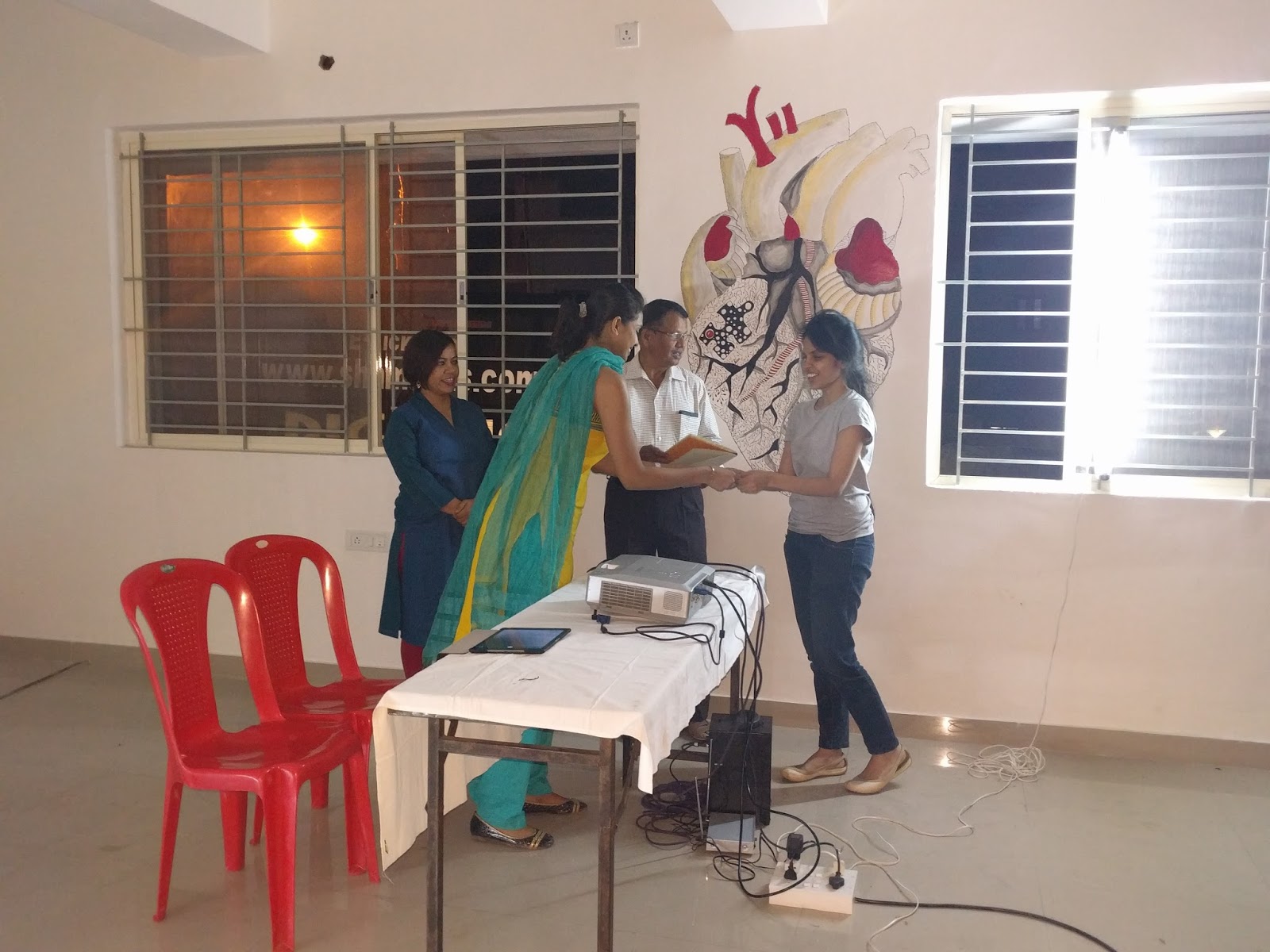
We at AarogyaSeva were lucky enough to have 6 artists come down yesterday to help decorate the walls of our soon to be open AarogyaSeva Karuna Clinic right near the Siddaoura Lalbagh Gate.

As Poornima, one of our artists said, it was bridging art and health via an Art to Heart Collective. Each artist had her own style and interpretation of the heart and it all come together in such beautiful way.

Two of the artists are still working on their pieces and photos will be posted of their completed works in the come week.

The kids in the neighbourhood come by throughout the day and really enjoyed watching the artists work. In fact some of the time they had too much fun just hanging out inside the clinic.

We were honoured to also run the trailer to Meryll a story about a young girl who lives in seclusion until when a series of events open a dark alley that bring back her worst nightmares to life.


We also ran an impromptu community session with thanks to Dr Karishma Kagod who spoke to women in the neighbourhood about giving themselves a voice and looking after themselves as they are the centre of the community and their families.  Dr Karishma is a plastic surgeon who is head of burns unit at Kolar Medical College.


Special thanks to Madhu from By the River who helped give thanks to our artists.  If you're after a storyteller please feel free to connect with her at:  By the River

I look forward for the clinic to be finished and for the community to be able to use the space.

You may have also noticed that we launched our campaign yesterday with the aim of providing 250 refugees with sanitary napkins for $20 per person.   Please support this worthwhile cause:  AarogyaSeva: Health, Dignity for female refugees

If you would like to volunteer or contact the author please drop us a line at Volunteer@aarogyaseva.org


Disclaimer: The opinions expressed within this article are the personal opinions of the author. The facts and opinions appearing in the article do not reflect the views of AarogyaSeva and AarogyaSeva does not assume any responsibility or liability for the same.


Thursday, February 25, 2016

March 8 International Women's Day Event


International Women's began with women protesting against wages and conditions within the textile industry at the turn of the 20th Century and has since grown into a global movement on March 8th. 

Annually around the world events are held that celebrate women’s contribution to society from fun runs, breakfast panels, gala events to festivals. 

We are excited to announce that AarogyaSeva will conducting an event at our soon to be open new AarogyaSeva Clinic- AarogyaSeva Karuna Clinic opposite the Lalbagh Siddapura gate on International Women’s Day.

The new AarogyaSeva Clinic centre will not only be a free clinic but also a prosthetic limb centre. Disability is an important public health problem in India with 2.6 million people living with a disability according to the 2011 census.

The clinic will house a 3-D printer with a focus on creation of upper limb prosthesis for children.   The recipients will be involved in designing, printing and assembling the limb making it an experiential and empowering process. 

It is intended that in collaboration with our partner organisations- The Challenging Ones, Association of People with Disability, IEEE, BMS College of Engineering and Rochester Institute of Technology least 25 limbs will be created in the first year.  

In additional we are seeking to use the space to provide workshops, education and awareness on 3D printing and health as well as allowing students and innovators to experiment with creating low cost medical solutions.

So please come along on March 8th and see the new clinic and support the female artists! Looking forward to seeing you all there. 

If you are interested in learning more or providing assistance please write to us at  Volunteer@aarogyaseva.org


Monday, February 15, 2016

Sanitary Napkins and Feminine Hygiene


Seeing the sanitary napkins women empowerment project whilst as part of 2016 Medical Yatra made me want to look into this topic a bit more.


For someone from a developed country we do not think much with regards to this area of female hygiene nor do we generally have any issues with access to sanitary napkins or tampons. Yet many women around the world still use scraps of dirty cloths which they cannot clean or sanitise properly.  Alarmingly I read that up to 70% of all reproductive diseases in India are caused by poor menstrual hygiene.


For so many women around the world menstruation is still a taboo subject with many restrictions placed on the women particularly around isolation as they are considered unclean.  Yet I can see why the commercially available products are not used openly and freely as women especially in rural villages have trouble to access, afford and dispose of them properly.  Further to this there is still much lacking on education on menstruation and female hygiene.


Fortunately there are several different projects currently in place using different approaches to address this issue including the use of cloths and menstrual cups.


This is the first time I’ve come across menstrual cups like SheCup or Ruby Cup. Both use a medical grade silicon cup which is inserted in the vagina like a tampon. The benefits of these are that they are much cheaper and better for the environment than commercially available sanitary napkins.   


Another project/initiative is Goonj’s Not Just a Piece of Cloth (NJPC) which was established in 2005 and has expanded globally.  They use old/discarded cloth to create reusable sanitary napkins and use this as platform to engage and educate about female hygiene whilst also providing job opportunities.  


The basis of the project that I saw at the Gram Seva Trust Hospital is related to the work Arunachalam Muruganantham and his company Jayaashree Industries.  What is particularly inspiring about Arunachalam is that he did not finish high school and that what began as a way to impress his new bride has evolved to something so much more which included him testing sanitary pads himself with the use of animal blood. I highly recommend watching Arunachalam TED talk from 2012. A documentary called 'Menstrual Man' has been created about him and his work.


What I love about the project I saw is that it is run by women for the women giving them a much needed low cost solution and income. Furthermore the pads are biodegradable reducing our impact on the environment particularly given that waste disposal is another burden particularly in rural areas.


As with all things I believe that a variety of different solutions are needed to address this issue as there is never a one size fits all to any problem.


I’d like to leave you all with an amusing advertisement we have in Australia which shows the marked difference between the countries views on the topic. https://www.youtube.com/watch?v=rg2-ZzSBl5s

Links on that mentioned above can be found below.


Disclaimer: The opinions expressed within this article are the personal opinions of the author. The facts and opinions appearing in the article do not reflect the views of AarogyaSeva and AarogyaSeva does not assume any responsibility or liability for the same.


To get in touch with the author or to join our team write to us at – Volunteer@aarogyaseva.org


Sunday, February 7, 2016

2016 AIPNO Medical Yatra


As was previously noted, Aarogyaseva was again part of 2016 Medical Yatra in Gujarat which ran from 23rd January to 30th January in connection with the following organisations
  • Association of Indian Physicians of Northern Ohio (AIPNO)
  • Action Research in Community Health (ARCH)
  • Rotary Club of Dharampur 
  • Shabri Chhatralaya
  • Intal

It brought 37 both medical professionals and general volunteers from USA, UK, India and Australia in conjunction with local health workers, Rotarians and ARCH workers.  We had with us a mix of internal/family doctors, emergency physicians, paediatricians, obstetrics/gynaecologists, dentists and an orthopaedic surgeon.  Apart from seeing the patients we also conducted CPR and dental hygiene education sessions as well as have patients take part in blood pressure research.


AIPNO was founded in 1983 and is a non-profit membership organisation of physicians of Indian origin in Northern Ohio. It has membership of 300 physicians and have they organised Medical Yatras since 2001.  They have provided aid to Mexico, Haiti, Peru, Ecuador, Uganda, Kenya, Honduras, Dominican Republic, Burundi and India. What is amazing is that the volunteers who came were in the late 60s and 70s who were either semi retired or retired.  Visit their website http://www.aipno.org/ for more information

ARCH currently provides provides primary health care services to approximately 25,000 patients along with basic health education and preventative services such as vaccinations and prenatal care. In addition they provide movie health camps in surrounding villages.  More about them can be found here: http://www.archgujarat.org/ 

We were split into 2 groups each visiting 5 locations over 5 days seeing up to 1,000 patients daily and ~4,000 patients in total. (The exact numbers are still to be finalised.)  People came from nearby villages and waited patiently for several hours to be seen. At each spot we spent 4-8 hours depending on the number of patients that presented.   For some of us we stepped into unfamiliar roles of dental, paediatric, gynaecology or pharmacy assistants, whilst others had to recall prior knowledge to diagnose, prescribe and dispense medications.   All of us had to improvise with limited supplies and diagnostic tools whilst working in a team to provide the best possible outcome.

Each stop was unique with a different variety of diagnosis and facilities. On some days it took us only about 30 minutes to get there and on others over 90 minutes across dirt roads. The majority of time we were situated within the local school which meant the kids had a disruptive day and were free to interact with the group, be seen by paediatricians or dentists and/or attend educational sessions being run. Regardless of where we were, the locals were all very welcoming and patient. It was heartwarming to see some of the older children assist with translation, directing people and/or helping the older patients to where they needed to go. 


Undernutrition was massive problem with 14-16 year old teenagers looking like they were 9-10 years old. The adults on the other hand looked much older than they should be due to physical outdoor labour with in many cases extremely high blood sugars and blood pressures. 

Language was a massive issue with local tribal languages being spoken in many instances as opposed to Gujarati or Hindi which become a case requiring up to 3 interpreters sometimes depending on the translator and Doctor.   


Observations

  • all who came were strong, happy and didn’t complain about the wait or their lot in life with physical examinations easy due to the lack of fat (many of those in their 40s/50s had six pack abs!) 
  • Biggest issues were undernutrition, undiagnosed hypertension, diabetes, goitres, cataracts, dry skin and cavities 
  • Introduction of fluoride, reduced salt and sugar diets and iodised salt would greatly assist these communities as part of preventable health schemes  
  • Girls were particularly shy with all being curious particularly around the tall Americans, our smart phones and cameras 
Outcomes from 2016 Medical Yatra
  • Recommendations to reduce cavities and improve teeth health particularly in children to be provided to local government officials 
  • ARCH has committed to follow up patients seen including scheduling of 33 cataract surgeries 
  • A piece for AJ+ (on online news and current events channel by Al Jazeera Media Network AJMN) is being finalised.  


All of us came with open hearts, warm smiles, positive and flexible attitudes and a sense of humour but left with so much more.  We have much to learn from each other and language is not a barrier.


I would highly recommend going on Medical Yatra as it is so much more than volunteering with an amazing bunch of people and seeing the countryside and interacting with the locals in a unique way as it includes component of spirituality as we stayed at Shrimad Rajchandra Mission Dharampur and were even fortunate enough to have an audience with Baba Pujya Gurudevshri Rakeshbhai.  More about the Ashram and their work is here: http://www.shrimadrajchandramission.org/

More photos are available here: https://www.facebook.com/media/set/?set=a.1582019118687142.1073741860.1384301005125622&type=1&l=4335feceba 

Number of Doctors: 14 including 2 dentists
Total number of volunteers: 37
Number of patients seen: ~4000
Number of sites visited: 10 

Volunteer hours (based on average 6 hour day for 37 volunteers) : 1110 hours